There is no certification program for payer APIs under CMS-0057-F, and no public registry of results. A health plan that wants to know whether a vendor’s Patient Access or Provider Directory API actually conforms has two options: take the vendor’s word for it, or run a conformance kit and read the findings.
The kits are free and public, and they are built for the ONC (the Office of the National Coordinator for Health IT). They are also easy to misread. A kit tests one implementation guide, at one version, in the groups you choose to run. It doesn’t test the regulation. This article maps the four kits Cloud Health Office runs every night to the APIs and rules they speak to, and is explicit about where the mapping stops.
The latest published verdict from each kit, with every failing test and every known kit issue, is on the Inferno conformance results page. CI updates it after each nightly run, so it stays current when this article doesn’t. In the October 31, 2026 run on main, all four kits passed, with the known kit issues described below recorded and not counted: five CARIN Blue Button tests and 25 Plan-Net tests.
Two more kits now run every night: Da Vinci PDex (the Payer-to-Payer member match) and Da Vinci DTR (the documentation step of the Prior Authorization API). With them, all six kits pass. This article still covers the original four in depth; the results page describes what PDex and DTR check and their known kit issues.
Update, 23 November 2026: the Da Vinci CRD and PAS kits and the SMART App Launch kit joined the nightly run, so nine kits now judge Cloud Health Office, and all nine pass.
On this page
- The short answer
- US Core: the floor under every payer API
- CARIN Blue Button: Patient Access claims data
- Plan-Net: the public Provider Directory
- Bulk Data and SMART Backend Services: Provider Access and Payer-to-Payer
- What no kit here checks
- The same kits outside CMS-0057-F
- How to read a vendor’s results, including ours
01The short answer
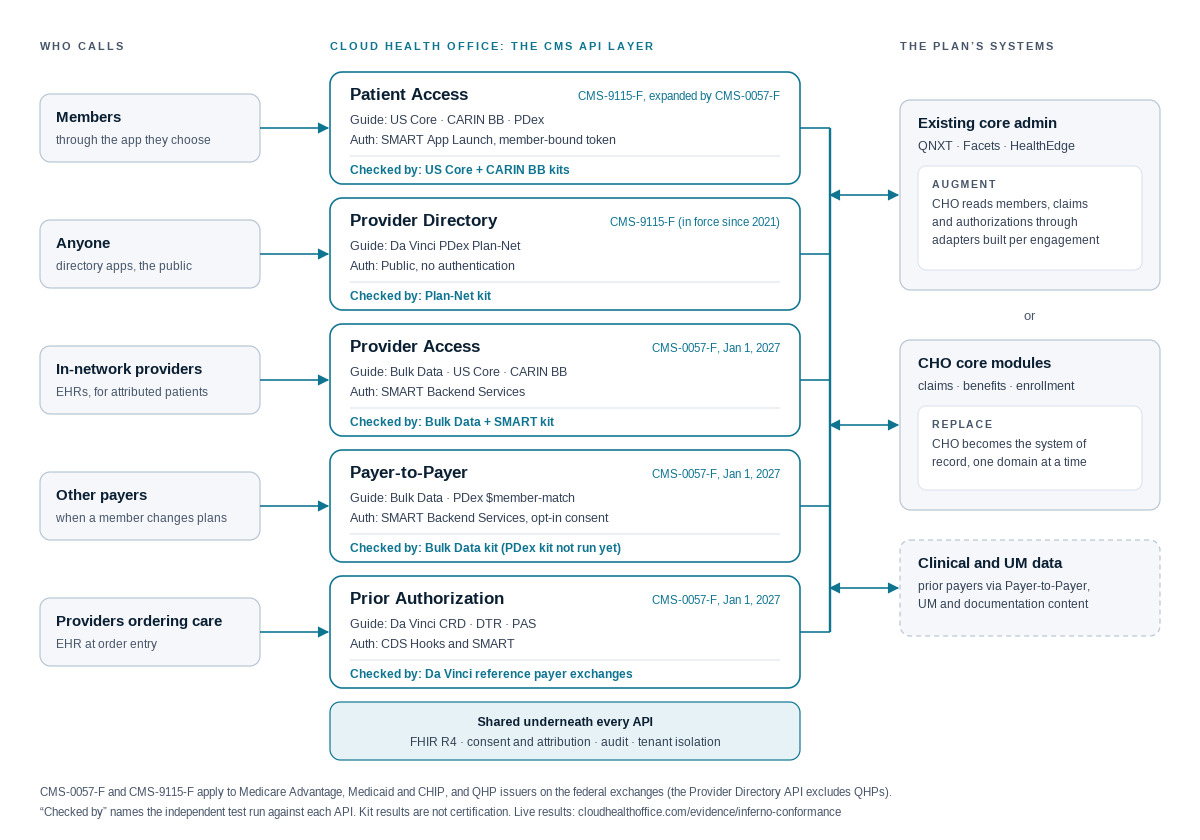
CMS-0057-F, the Interoperability and Prior Authorization final rule, builds on CMS-9115-F, the 2020 Interoperability and Patient Access rule. Together they require Medicare Advantage organizations, Medicaid and CHIP programs and managed care plans, and Qualified Health Plan issuers on the federally facilitated exchanges to run FHIR R4 APIs that follow the ONC API standards at 45 CFR 170.215. For what goes inside each API, CMS recommends specific HL7 implementation guides. Each Inferno kit checks one of those guides.
| API | From | Standard or recommended guide | Inferno kit |
|---|---|---|---|
| All payer FHIR APIs | CMS-9115-F, CMS-0057-F | FHIR R4, US Core, SMART App Launch (45 CFR 170.215) | US Core |
| Patient Access: claims and encounters | CMS-9115-F, expanded by CMS-0057-F | CARIN Blue Button | CARIN for Blue Button |
| Provider Directory | CMS-9115-F | Da Vinci PDex Plan-Net | Da Vinci Plan-Net |
| Provider Access | CMS-0057-F, January 1, 2027 | Bulk Data Access, SMART Backend Services | Bulk Data |
| Payer-to-Payer | CMS-0057-F, January 1, 2027 | Bulk Data Access, Da Vinci PDex | Bulk Data (PDex kit not run yet) |
| Prior Authorization | CMS-0057-F, January 1, 2027 | Da Vinci CRD, DTR, PAS | Not run here (see section 06) |
Two things follow from that table. First, a kit result is evidence about one API, not about the rule. Second, the rules require the base standards and only recommend the guides, so a payer can be compliant with a different, well-documented design. In practice almost nobody does that, because every app developer, provider system and other payer on the other side of these APIs is building against the recommended guides.
02US Core: the floor under every payer API
What the rule asks. The ONC API standards at 45 CFR 170.215 include the US Core implementation guide, and CMS-0057-F adopts them for payer APIs. US Core 3.1.1 is the floor, and the rules let a payer use a later version that ONC has approved. Every payer API that returns clinical or demographic data rests on it, including Patient Access, Provider Access and Payer-to-Payer.
What the kit checks. The US Core test kit reads the server’s CapabilityStatement, then for each profile it reads resources by id and runs every search the guide makes mandatory, alone and in the required combinations. It checks that each must-support element appears somewhere in what came back, that references resolve, and it sends every resource it received to the HL7 FHIR validator against the US Core profile it claims.
What we run. Kit v1.1.6, suite us_core_v311, with three groups: the CapabilityStatement, Patient and Encounter. US Core 3.1.1 has groups for roughly thirty clinical resource types, such as Observation, Condition and Immunization, and a payer serves almost none of them from its own systems. Running the whole suite would bury the Patient and Encounter results under failures for resources we never claimed. Naming the groups says exactly what was tested. It doesn’t soften the verdict on those groups.
Which US Core groups did you run, at which kit version, and which US Core version? “We pass US Core” with no groups named usually means a few groups passed. US Core 6.1.0 is the version ONC now certifies EHRs against, and it is the natural next run for payers too.
03CARIN Blue Button: Patient Access claims data
What the rule asks. The Patient Access API has been required since CMS-9115-F. It must give members, through the app of their choice, their claims and encounter data, clinical data, and (for plans with drug coverage) formulary information. CMS-0057-F adds prior authorization information by January 1, 2027. CMS recommends the CARIN Consumer Directed Payer Data Exchange guide, usually called CARIN Blue Button, for the claims portion.
What the kit checks. The CARIN for Blue Button test kit works through Patient, Coverage, ExplanationOfBenefit, Organization and Practitioner. For ExplanationOfBenefit it runs the searches the guide requires: by patient, by _id, by _lastUpdated, by type, by identifier, by service date and billable period, and with the _include parameters that pull in the patient, provider, care team, coverage and insurer. It then validates each EOB against the CARIN profile for its claim type: inpatient and outpatient institutional, professional, pharmacy, and oral.
What we run. Kit v0.16.3, suite c4bb_v200, with the financial “C4BB FHIR API Tests” group in a single run: the CapabilityStatement, Patient, ExplanationOfBenefit, Coverage, Organization, Practitioner and RelatedPerson. The kit runs as a member’s SMART patient app, with a token bound to that one member, because that is how a consumer app reaches Patient Access. The RelatedPerson tests skip, since we publish no RelatedPerson, and the visual inspection group is manual by design.
Known kit issues. The five claim-type validation tests (inpatient, outpatient, professional non-clinician, pharmacy and oral) can’t be passed by any server that holds more than one claim type. In v0.16.3, the latest release, each of them validates every EOB the kit collected against that one claim type’s profile. We record their failures and list them, but don’t count them. Each EOB is still validated against its own profile by the HL7 validator in our own test suite. The kit’s non-financial suite also isn’t run, because it checks profile URLs from a superseded 2023 draft rather than the CARIN BB 2.2.0 profiles we declare. Why we didn’t rename our profiles to make it pass.
04Plan-Net: the public Provider Directory
What the rule asks. CMS-9115-F requires Medicare Advantage organizations, Medicaid and CHIP to publish their provider directory as a FHIR API that anyone can query without authentication. It must include provider names, addresses, phone numbers and specialties, and Medicare Advantage plans with drug coverage must include their pharmacy directory too. CMS recommends the Da Vinci PDex Plan-Net guide.
What the kit checks. The Da Vinci Plan-Net test kit covers all nine directory resource types: Endpoint, InsurancePlan, Network, Organization, OrganizationAffiliation, Practitioner, PractitionerRole, Location and HealthcareService. For each one it runs the guide’s searches, then the forward chains (such as practitioner roles whose organization has a given name), the reverse chains, _include and _revinclude, the must-support check and profile validation. A directory that can list providers but can’t answer “which in-network locations offer this specialty” fails the chained-search tests, and those are the queries a real directory app makes.
What we run. Kit v0.13.4, the whole suite, against the public directory endpoint with no token. The token is left unset on purpose, because a run with a token wouldn’t prove the directory is public. One version gap applies: the kit is generated from Plan-Net 1.1.0 and we serve 1.2.0.
Known kit issues. 25 forward-chain tests are recorded and not counted. In v0.13.4, the latest release, each one takes its search value from the first resource of that type the kit happened to collect, usually the payer’s own Organization, and fails when nothing points at that one resource. A directory that links its practitioners and locations to the practices that run them returns nothing for that search, which is the correct answer. The forward chains whose first value is referenced pass, and our own tests cover chained search directly.
05Bulk Data and SMART Backend Services: Provider Access and Payer-to-Payer
What the rule asks. CMS-0057-F adds two system-to-system APIs, due January 1, 2027. Provider Access lets in-network providers retrieve claims, encounter and clinical data (plus prior authorization information) for the members attributed to them. Payer-to-Payer moves a member’s data to a new plan when they switch. Both must support FHIR Bulk Data Access, so a provider or payer can export a whole patient group at once. The calling system is authorized with SMART Backend Services, the signed-JWT client credential the Bulk Data guide defines, with no user in the loop.
What the kit checks. The Bulk Data test kit starts with SMART discovery and the token endpoint. It checks that a bad grant type, a bad assertion type and an invalid JWT are each refused, and that a valid signed assertion gets a properly formed token. Then it runs $export for a Group and for all patients: the kick-off request, status polling, the completion manifest, downloading each NDJSON file with the token the manifest requires, validating the resources inside, cancelling an export, and the _outputFormat and _since parameters.
What we run. Kit v0.13.2, suite bulk_data_v200, with the SMART Backend Services, Group export and Patient export groups. The kit signs in as a backend client we register for the run, bound to one seeded provider, and the group it exports is that provider’s attributed patients. So the token, the provider binding and the export are the real Provider Access path. The token-endpoint TLS test is switched off in the nightly, because the test network is plain HTTP. That group passed over real TLS on hosted Inferno against our demo environment on October 29, 2026. The system-level export group isn’t run, since we don’t serve system-level export.
What it doesn’t reach. Payer-to-Payer also needs $member-match and the PDex profiles. The Da Vinci PDex kit covers those. We have it pinned but don’t run it yet.
06What no kit here checks
This is the part of the mapping that matters most to a compliance lead, because it is where a green dashboard can be misread.
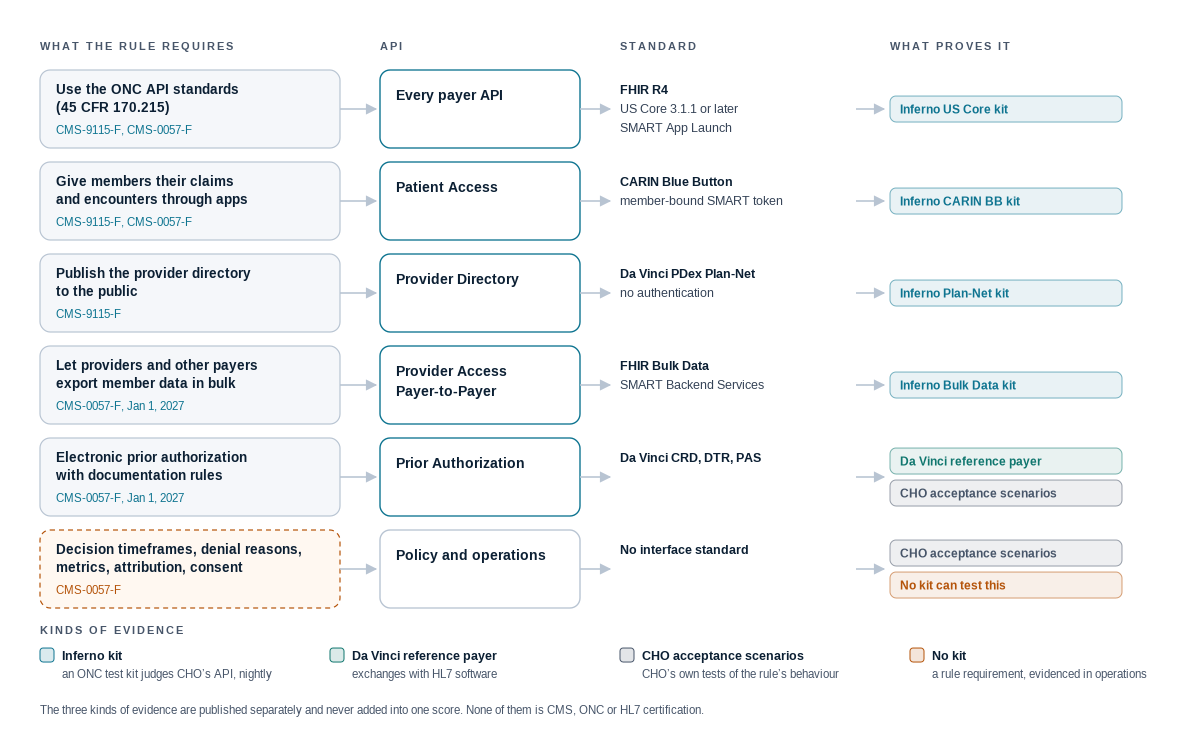
The Prior Authorization API. CRD, DTR and PAS have their own Inferno kits. We don’t run them yet. Our prior authorization evidence today is real exchanges with the HL7 Da Vinci reference payer and our own acceptance scenarios.
Patient Access clinical and formulary data. These are covered by the PDex and US Drug Formulary guides and their kits, which aren’t part of this run.
Policy and operations. No kit checks prior authorization decision timeframes (72 hours expedited, 7 calendar days standard), denial reasons, provider attribution, the Provider Access opt-out, Payer-to-Payer opt-in consent, the public prior authorization metrics, or Patient Access usage reporting. These are rule requirements, not interface requirements, and a payer has to evidence them some other way.
Production. A kit run against a sandbox says nothing about uptime, data completeness, or whether production data matches the sandbox.
07The same kits outside CMS-0057-F
The US Core, SMART and Bulk Data kits aren’t payer-specific. ONC uses them in its Health IT Certification Program, for the standardized API criterion that certified health IT such as EHRs must meet, and the official record of those results is ONC’s Certified Health IT Product List. That program certifies EHR technology. Payers and payer platforms aren’t in it, which is why no comparable list exists for payer APIs.
This has two practical consequences. The provider systems on the other end of Provider Access are being certified against the same standards these kits check, so a payer API that passes them is speaking the same dialect. And when ONC moves the baseline, as it did in moving EHR certification from US Core 3.1.1 to 6.1.0, payers can expect the same versions to follow through the version-advancement process that CMS-0057-F allows.
CARIN Blue Button and Plan-Net, by contrast, exist mainly because of the CMS payer rules. Medicaid agencies and their managed care plans reach for them for the same reason, since the federal Patient Access and Provider Directory requirements apply to Medicaid and CHIP as well.
08How to read a vendor’s results, including ours
Five questions separate a meaningful conformance claim from a decorative one:
- Which kit, which release? Results change between kit versions. Ours are pinned by release tag and commit.
- Which groups? A suite with half its groups skipped can still show a green summary.
- With what credentials? A Patient Access test run with an administrator token proves less than one run as a member’s app. A directory test run with a token doesn’t prove the directory is public.
- What was excused, and why? Every kit has rough edges. They should be listed with a reason, not filtered out silently.
- When, and against what? A result from a sandbox six months ago describes a different system.
Our results page answers all five for every kit, from the snapshot CI publishes after each nightly run. If a result there is red, it is red because the kit said so.
DisclosureWhere we sit in this
Cloud Health Office sells payer interoperability software, so read this with that in mind. The harness, the kit pins, the scenario inventory and the known kit issues are all in the public repository. We claim no certification by, affiliation with, or endorsement from CMS, ONC, HL7, CARIN Alliance or the Inferno project. Regulatory summaries here are for orientation. The rule text and your counsel are the authority.