Judged every night by tests we did not write.
Nine open-source Inferno test kits run against Cloud Health Office on a nightly schedule: US Core, CARIN Blue Button, Da Vinci Plan-Net, Bulk Data with SMART Backend Services, Da Vinci PDex (payer-to-payer member match), Da Vinci DTR, CRD and PAS (the three prior authorization steps) and SMART App Launch. The latest results are published below as the kits reported them, including the failures.
Inferno is the open-source FHIR conformance testing framework built for the ONC (the Office of the National Coordinator for Health IT). Each test kit encodes one implementation guide's requirements and drives an API the way a real client would. There is no public registry of payer results, so we publish ours here.
Latest published results
CI writes this snapshot after each nightly run on the main branch. A run that dies before it produces evidence leaves the previous snapshot in place, so a broken night can't wipe out real results. A kit with no result is never shown as passed.
Loading the published Inferno conformance evidence. It records each kit's verdict, the pinned kit release, the groups that were run, and every test that did not pass.
What each kit tests, and the requirement behind it
CMS-0057-F and the earlier CMS-9115-F require payer APIs built on FHIR R4 and the ONC API standards at 45 CFR 170.215. For the content of each API, CMS points to specific HL7 implementation guides. Each kit below checks one of those guides.
| Kit | What it checks | What Cloud Health Office runs | Requirement it speaks to |
|---|---|---|---|
| US Core us-core-test-kit v1.1.6 |
The CapabilityStatement; read and the required searches on each profile; must-support elements; references that resolve; every returned resource validated against its US Core profile by the HL7 validator. | Suite us_core_v311: the CapabilityStatement, Patient and Encounter groups. Those are the US Core resources a payer serves. The other clinical groups are not run. |
The ONC API standards that CMS-0057-F adopts by reference. US Core 3.1.1 is the floor, and it underlies Patient Access, Provider Access and Payer-to-Payer. |
| CARIN Blue Button carin-for-blue-button-test-kit v0.16.3 |
Patient, Coverage, ExplanationOfBenefit, Organization and Practitioner reads and searches, including EOB searches by type, identifier, service date and _lastUpdated, the _include parameters, and validation of each EOB against its claim-type profile. |
Suite c4bb_v200, the financial API test group in one run, as a member's SMART patient app with a token bound to that member, the way a consumer app reaches Patient Access. |
The Patient Access API: claims and encounter data for members, required since CMS-9115-F and expanded by CMS-0057-F. CARIN Blue Button is the guide CMS recommends for it. |
| Da Vinci Plan-Net davinci-plan-net-test-kit v0.13.4 |
All nine directory resource types: searches, forward and reverse chained searches, _include and _revinclude, must-support elements, and profile validation. |
The whole suite, against the public Provider Directory with no access token, because the rule says the directory is public. | The Provider Directory API, required since CMS-9115-F and open to the public without authentication. Plan-Net is the guide CMS recommends for it. |
| Bulk Data + SMART Backend Services bulk-data-test-kit v0.13.2 |
SMART discovery and the Backend Services token endpoint, including refusals of a bad grant type, assertion type or JWT. Group and Patient $export: kick-off, status polling, the manifest, authorized NDJSON download, resource validation, cancel, _outputFormat and _since. |
Suite bulk_data_v200: the SMART Backend Services, Group export and Patient export groups. The client is a registered backend bound to a seeded provider. |
The Provider Access and Payer-to-Payer APIs, due January 1, 2027, which must support FHIR Bulk Data with system-to-system authorization. |
| Da Vinci PDex davinci-pdex-test-kit v0.13.2 |
The CapabilityStatement declares $member-match; the HRex request (the member's demographics, the coverage to match and the member's consent) is valid; a match returns the member's identifier; and a request that matches no one is refused with an OperationOutcome. |
Suite pdex_payer_server: the member-match workflow and no-match groups. The kit acts as the new payer and signs in with SMART Backend Services as a registered payer, so the token, the payer binding and the consent check are the real path. |
The Payer-to-Payer API, due January 1, 2027: the new payer finds the member at the previous payer before asking for their data. PDex and HRex are the guides CMS recommends for it. |
| Da Vinci DTR davinci-dtr-test-kit v0.18.0 |
DTR operations in the CapabilityStatement; $questionnaire-package by form, by CRD context and by order; adaptive forms through $next-question; ValueSet/$expand; every package validated against the DTR profiles; the error cases; and $log-questionnaire-errors. |
Suite dtr_payer_server_v220: discovery, SMART Backend Services, the questionnaire operations and error logging. The kit plays a provider's DTR client against CHO's standard MRI form and its adaptive sleep-study form. |
The Prior Authorization API, due January 1, 2027: the provider learns what documentation the plan needs and fills it in. DTR 2.2.0 is the guide CMS recommends for that step. |
| Da Vinci CRD davinci-crd-test-kit v0.15.0 |
CDS Hooks discovery and its CRD configuration extensions; the CDS Hooks 2.0 client JWT; and the coverage-information answers to order-sign, order-select and the other hooks, including not-covered and technical-issue answers. |
Suite crd_server_v221, all groups. The kit plays the EHR and signs each hook call; CHO trusts that one client by issuer and key set. |
The Prior Authorization API, due January 1, 2027: the provider learns at order time whether authorization or documentation is needed. CRD 2.2.1 is the guide CMS recommends for that step. |
| Da Vinci PAS davinci-pas-test-kit v0.16.0 |
Claim/$submit and $inquire for approved, denied and pended requests; claim updates; must-support elements of the request and response; the error cases; and the Subscriptions R4 backport notification of a pended decision. |
Suite davinci_pas_server_suite_v221, all groups. The kit plays a provider's PAS client over SMART Backend Services. To the kit's must-support requests the harness adds its own (a pend that asks for documentation, a preferred alternative, a refused request), so the optional response elements are shown rather than merely allowed. |
The Prior Authorization API, due January 1, 2027: the request, the decision and its status. PAS 2.2.1 is the guide CMS recommends for it. |
| SMART App Launch smart-app-launch-test-kit v1.0.3 |
SMART discovery, v2 scopes, standalone and EHR launch with refresh, Backend Services, and token introspection. | Suite smart_stu2_2: the full standalone launch, full EHR launch, Backend Services and token introspection groups, against cho-smart-auth-service. |
The authorization every CMS-0057-F API sits behind: SMART App Launch for member apps on Patient Access, and Backend Services for provider and payer systems. |
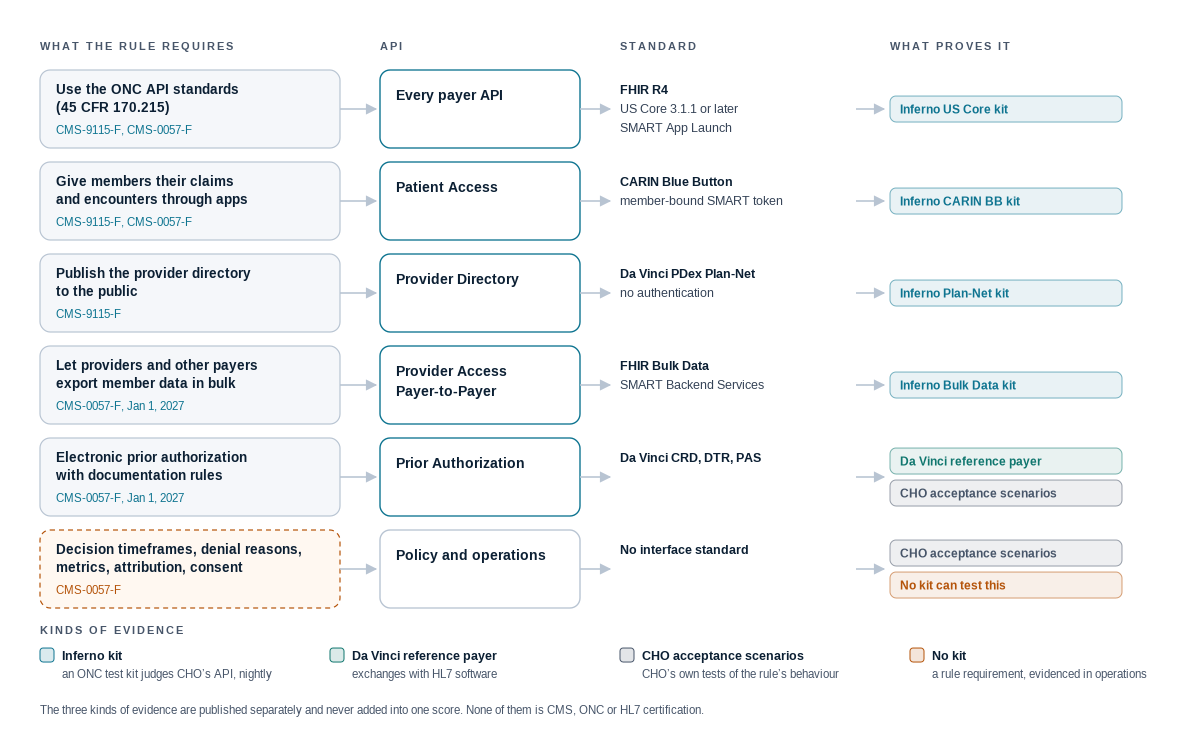
For the full account of each kit, the CMS-0057-F API it maps to, and the requirements no kit can check (prior authorization decision timeframes, attribution, consent, metrics reporting), read Which Inferno test kit checks which CMS-0057-F API.
Known kit issues and version gaps
A kit is software with a version, written against a specification that keeps moving. Where a kit can't judge any server, or checks a different version than the one we serve, it is listed here and in the snapshot, with the reason. Nothing is quietly dropped.
CARIN BB: the five EOB claim-type checks
In kit v0.16.3, the latest release, each claim-type validation test (inpatient, outpatient, professional non-clinician, pharmacy and oral) checks every EOB the kit collected against that one claim type's profile. A member with both professional and institutional claims therefore fails the pharmacy profile on EOBs that never claimed it. No server with mixed claim types can pass these tests. Their failures are still recorded, but they don't count against the result. Each EOB is still validated against its own profile by the HL7 validator in our own test suite.
CARIN BB: the non-financial suite is not run
The kit's non-financial suite checks the superseded -NonFinancial profile URLs from an April 2023 snapshot. Cloud Health Office declares the current CARIN BB 2.2.0 -Basis profiles, so the suite can't match its EOBs in either direction. We won't rename our profiles to an outdated draft just to turn it green.
Plan-Net: 25 forward-chain searches, and kit 1.1.0
In kit v0.13.4, the latest release, a forward-chain test takes its search value from the first resource of that type the kit happened to collect, usually the payer's own Organization. It fails if nothing points at that one resource, even when the directory links every practitioner, location and service correctly to the practice that runs it. Those 25 tests are recorded and not counted. The forward chains whose first value is referenced pass, and our own tests cover chained search directly. Separately, the kit is generated from Plan-Net 1.1.0, while Cloud Health Office serves 1.2.0, so where the two versions differ the kit checks the older one.
Bulk Data: TLS and system export
The nightly runs on a private plain-HTTP network, so the token-endpoint TLS test is switched off with the kit's own setting. That group passed over real TLS on hosted Inferno against our demo environment on October 29, 2026. The system-level export group isn't run, because Cloud Health Office doesn't serve system-level $export.
PDex: payer-to-payer query groups not run
Kit v0.13.2 is generated from PDex 2.0.0. Cloud Health Office exchanges payer-to-payer data the PDex 2.1.0 way, by bulk $davinci-data-export after the member match, so the kit's 2.0 query workflow groups are not run. The member-match groups, which both versions share, are.
DTR: three tests no conformant server can pass
In kit v0.18.0, the latest release, two must-support tests require elements that the DTR 2.2.0 profiles prohibit (the base Questionnaire's assemble-expectation and item display extensions, and items on an adaptive search form, which carries none by design). A third reads a Library's terminology dependencies as missing Libraries. The three are recorded and not counted. Every returned Questionnaire and Library is still validated against its DTR profile by the kit's other tests.
How the run works, and how to repeat it
The nightly job starts a Cloud Health Office stack and the nine kits together on an isolated network. It
seeds synthetic members, claims, coverage and a provider directory, checks that Cloud Health Office
answers its own metadata endpoint, and then hands each kit its inputs. Each kit is pinned to
a release tag and commit in interop/versions.json. The groups each kit runs, and the known kit
issues, are listed in interop/scenarios.json. Changing either one takes a reviewed pull request.
You don't have to trust our runner. The same kits are hosted at
inferno.healthit.gov, and the harness is in the public
repository (./scripts/interop/run.sh inferno all). A health plan can point a kit at a Cloud
Health Office sandbox, or at any vendor's sandbox, and read the findings for itself.
What these results do not establish
Limitations
- This is not certification. Running ONC's tool is not ONC, CMS or HL7 approval. CMS-0057-F has no certification program for payer APIs.
- A pass covers the groups that ran, at that kit version. It isn't a pass of the whole implementation guide, and it isn't a pass of CMS-0057-F.
- Synthetic data on a test stack. No production member data is involved, and no production deployment is claimed.
- The PAS kit passes every test, since November 23, 2026; until then six must-support tests failed and were logged as CHO gaps. PAS, CRD and DTR are also evidenced by exchanges with the HL7 Da Vinci reference implementation.
- Kit results and acceptance results stay separate. A kit result never changes a CMS-0057-F acceptance scenario status, and the two are never combined into one score.
Bring your own kit.
The kits are free and public, and so is the harness. If your team wants to run a kit against a Cloud Health Office sandbox, or against the APIs you run today, we'll set it up with you.