ConceptMap/$translate API
FHIR-native terminology translation with ~119,000 NLM/UMLS mappings, AMA CPT cross maps (BYOL), and tenant-scoped plan-specific overrides. Single-code and $batch-translate endpoints for real-time and bulk use.
Achieve CMS Interoperability and Prior Authorization compliance without replacing your core admin system. FHIR R4 APIs, Da Vinci IGs, and X12 EDI on a Kubernetes-native compliance layer.
Cloud Health Office is a modern payer administration and interoperability platform. It can operate alongside existing core administration systems such as QNXT, Facets, or HealthEdge, or progressively take over payer domains including eligibility, benefits, providers, prior authorization, claims, and accumulators.
For CMS-0057-F, a payer can start with an interoperability and readiness layer — FHIR R4 APIs, Da Vinci-aligned prior authorization, and terminology services deployed beside the core — and, over time, migrate individual domains onto Cloud Health Office as a payer core backend. It is not only a FHIR gateway or middleware shim: the same platform carries the adjudication, benefit, accumulator, and provider engines a payer core requires. See the platform overview and payer solutions for the full domain map.
The Advancing Interoperability and Improving Prior Authorization Processes final rule requires Medicare Advantage, Medicaid, CHIP, and QHP issuers to implement standardized FHIR R4 APIs — improving prior authorization, reducing provider burden, and enabling patient data access. Compliance deadline: January 1, 2027.
Concise, authoritative answers to the questions payer architects and technology leaders ask most about CMS-0057-F, FHIR APIs, prior authorization, and where Cloud Health Office fits. Each answer stands on its own and links deeper into the documentation.
CMS-0057-F is the CMS Advancing Interoperability and Improving Prior Authorization Processes final rule. It requires impacted payers — Medicare Advantage organizations, state Medicaid and CHIP programs, and Qualified Health Plan issuers on the federal Marketplaces — to expose standardized HL7 FHIR R4 APIs and to modernize prior authorization. The goals are patient and provider access to data, payer-to-payer data exchange, and faster, more transparent prior authorization decisions. Most API and prior authorization provisions carry a compliance date of January 1, 2027.
CMS-0057-F applies to Medicare Advantage organizations, state Medicaid fee-for-service programs and managed care plans, CHIP fee-for-service and managed care entities, and Qualified Health Plan issuers on the federally-facilitated Marketplaces. These impacted payers must implement the required FHIR APIs and prior authorization changes. Commercial and employer-sponsored plans are outside the federal rule's direct scope, though many adopt the same Da Vinci-aligned patterns. See who must comply for the detail by payer type.
CMS-0057-F requires four FHIR R4 APIs: a Patient Access API (claims, encounters, and clinical data via USCDI), a Provider Access API (member data to in-network providers), a Payer-to-Payer API (data exchange when members change plans), and a Prior Authorization API (status, decisions, and rationale). It also expands the existing Provider Directory API. Cloud Health Office implements all four as an implemented technical capability; each payer's data mapping is configured during onboarding. The compliance documentation maps each API to its FHIR resources.
CRD, DTR, and PAS are the three HL7 Da Vinci prior authorization Implementation Guides. Coverage Requirements Discovery (CRD) tells a provider, at the point of order, whether prior authorization is needed. Documentation Templates and Rules (DTR) gathers the required clinical documentation using FHIR Questionnaires. Prior Authorization Support (PAS) submits the request and returns the decision. PAS underpins the CMS-0057-F Prior Authorization API; CRD and DTR are Da Vinci-aligned capabilities CMS encourages rather than separately mandating in this final rule. The prior authorization guide walks the full flow.
No. CMS-0057-F requires FHIR APIs and prior authorization changes; it does not require replacing your core administration system. Cloud Health Office is designed to deploy as an interoperability and readiness layer beside an existing QNXT, Facets, HealthEdge, or Amisys core, which remains the system of record. The core keeps adjudicating claims and holding member data while Cloud Health Office exposes the required FHIR surfaces and Da Vinci-aligned prior authorization. Integration to each specific core is configured during onboarding — see the QNXT / Facets / HealthEdge architecture article.
Yes. Running alongside an existing core is the default deployment. Cloud Health Office reads member, coverage, provider, and claims data from the core through a vendor-neutral adapter, typically in a read-only augment mode, and exposes CMS-0057-F FHIR APIs, terminology translation, and Da Vinci-aligned prior authorization on top. Your core administration system stays in place as the system of record. The specific adapter and data mappings for QNXT, Facets, HealthEdge, or a custom core are configured during onboarding. The architecture documentation details the adapter model.
Yes, progressively. Beyond the interoperability layer, Cloud Health Office includes the engines a payer core requires — eligibility, benefits, provider data, prior authorization, claims adjudication, and accumulators. A payer can migrate one domain at a time onto Cloud Health Office rather than performing a single rip-and-replace, keeping the legacy core authoritative for the domains not yet moved. This progressive modernization path lets the same platform that delivered CMS-0057-F readiness grow into the payer core backend. The platform overview shows the domains available today.
A large one. Da Vinci workflows exchange clinical concepts in SNOMED CT and LOINC, while payer coverage rules and claims adjudicate in CPT and ICD-10-CM. Without translation between these code systems, a prior authorization request cannot be reliably matched to benefit configuration. Cloud Health Office includes a FHIR terminology service that performs SNOMED CT to CPT/ICD-10-CM translation via ConceptMap/$translate, with context-aware disambiguation and plan-specific overrides configured per payer. See the terminology guide for the mapping model.
Not entirely. CMS-0057-F adds a FHIR-based Prior Authorization API built on Da Vinci PAS, but the X12 278 transaction remains part of the ecosystem — clearinghouses and many trading partners still exchange 278. In practice PAS and X12 278 coexist, and a payer needs to translate between them. Cloud Health Office maps X12 278 to and from FHIR PAS resources so a single prior authorization can move across both worlds. The prior authorization guide covers the 278 ↔ FHIR mapping.
Cloud Health Office provides the implemented technical capability; a payer-specific implementation still requires configuration. During onboarding a payer maps its core data (members, coverage, claims, provider contracts) to FHIR resources, connects the core through the appropriate adapter, loads or reviews terminology and plan-specific coding overrides, sets prior authorization timelines and decision rationale, configures OAuth 2.0 and consent, and validates USCDI coverage. See the payer compliance checklist for the full list.
CHO deploys as a compliance layer alongside your existing core admin processing system. No replatforming. No rip-and-replace. Your CAPS stays in place — CHO handles FHIR, EDI, terminology translation, provider verification, and CMS compliance.

Compliance in Action
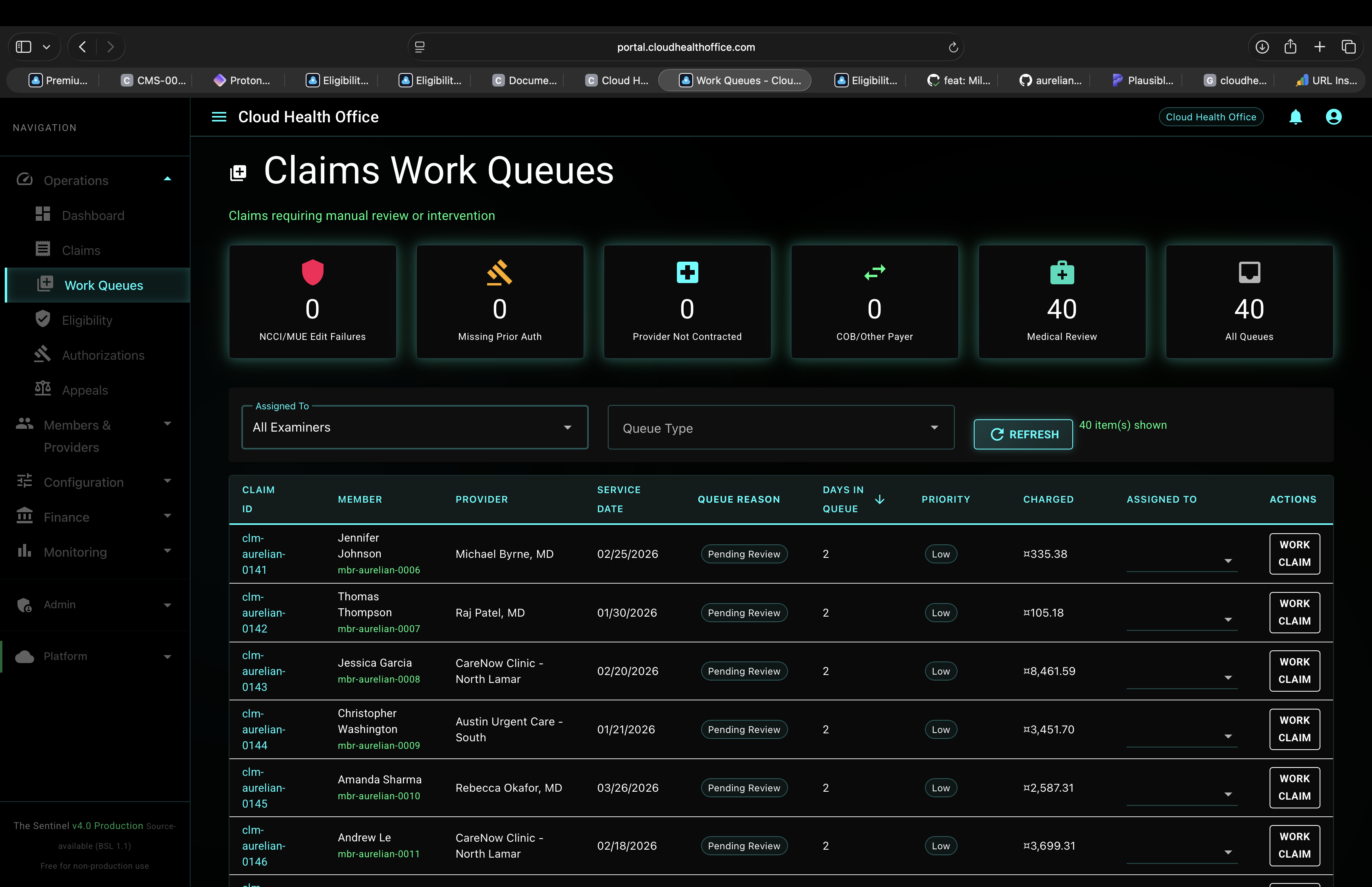
Every claim that enters Cloud Health Office is automatically routed through compliance-aware work queues. Prior authorization, COB coordination, provider contracting, and NCCI/MUE edits aren't bolt-on modules — they're native to the adjudication pipeline.
Claims failing National Correct Coding Initiative or Medically Unlikely Edit rules are automatically flagged and routed for examiner review.
CMS-0057-F requires prior auth decisioning with rationale. Claims requiring authorization that lack an auth on file are pended — not denied — per the PriorAuthDecisionEngine's configured pathways.
Coordination of benefits claims with primary, secondary, or tertiary payer involvement. Birthday rule, gender rule, and Medicare secondary payer logic handled natively.
Claims from providers without active contracts are flagged via the ProviderVerificationService — checking NPPES, OIG/LEIE, SAM.gov, PECOS, and CMS Open Payments for a composite integrity score.
Claims exceeding charge thresholds, unusual procedure combinations, or requiring clinical documentation are routed for medical director review with full audit trail.
X12 transactions from the core admin system can be transformed to FHIR R4 resources conforming to Da Vinci profiles through configurable, auditable mapping pipelines.
Da Vinci workflows (CRD, DTR, PAS) exchange clinical data in SNOMED CT. Your CAPS adjudicates in CPT and ICD-10-CM. Without built-in translation, prior auth requests cannot be matched to benefit configuration. Most implementations treat this as "customer responsibility." CHO solves it natively.
FHIR-native terminology translation with ~119,000 NLM/UMLS mappings, AMA CPT cross maps (BYOL), and tenant-scoped plan-specific overrides. Single-code and $batch-translate endpoints for real-time and bulk use.
When SNOMED maps to multiple ICD-10-CM codes, the context rule engine uses patient age, gender, state, co-morbidities, and plan coding policy to select the best match — not just the first match.
The CRD server, PAS server, and DTR engine consume the crosswalk at runtime. SNOMED codes from EHRs are translated to payer code space for coverage rules, prior auth decisions, and questionnaire pre-population.
Auto-loading at startup, runtime upload via Admin API, SHA-256 version tracking, and full audit trail. Plan-specific overrides support Texas TMPPM, state Medicaid variations, and custom coding policy per tenant.
Each CMS-0057-F capability below follows the same structure — a quick answer, how it works, how Cloud Health Office implements it, and links to the implementation evidence. For the full narrative, read the architecture article.
CRD tells a provider, while they are placing an order, whether a service needs prior authorization and what documentation applies. It runs through CDS Hooks so the answer appears inside the provider's EHR workflow.
The EHR fires an order-select or order-sign CDS Hook to the payer's CRD service, which evaluates coverage rules for the ordered code and member coverage, then returns cards indicating authorization requirements and pointing to a DTR questionnaire when documentation is needed.
Cloud Health Office evaluates coverage rules against the member's benefit configuration and the terminology service, so SNOMED-coded orders resolve to the payer's CPT/ICD code space before a rule fires. Coverage rules are payer-specific and configured during onboarding.
DTR collects the clinical documentation a prior authorization needs using a FHIR Questionnaire, pre-populating answers from the patient record so the provider fills in as little as possible.
The payer publishes a FHIR Questionnaire with embedded CQL logic. A DTR app renders it, pulls known values from the EHR, and returns a QuestionnaireResponse that travels with the authorization request into PAS.
Cloud Health Office produces and consumes FHIR Questionnaire and QuestionnaireResponse resources and carries the response through to the prior authorization submission. Questionnaire content is Da Vinci-aligned and tailored to each payer's policies during onboarding.
PAS is the FHIR mechanism behind the CMS-0057-F Prior Authorization API. It submits the authorization request and returns the decision, status, and rationale to the provider.
A provider system sends a Claim/$submit bundle containing the ServiceRequest and supporting documentation. The payer responds with a ClaimResponse carrying the decision. Where trading partners still use EDI, the request is bridged to and from the X12 278 transaction.
Cloud Health Office exposes a Da Vinci-aligned PAS endpoint and includes a 278→FHIR mapping prototype. Response timelines and decision rationale are set to each payer's policies during onboarding.
Prior authorization guide · PasController.cs · 278→FHIR mapping prototype
Terminology services translate between the SNOMED CT and LOINC codes used in clinical workflows and the CPT and ICD-10-CM codes used in payer coverage and claims, so prior authorization requests can be matched to benefit configuration.
A FHIR terminology server exposes ConceptMap/$translate. When one source code maps to several targets, a context engine uses member and policy attributes to choose the appropriate code rather than the first match.
Cloud Health Office ships a terminology service with ConceptMap/$translate, context-aware disambiguation, and tenant-scoped plan-specific overrides. Source mappings and payer coding policy are loaded and reviewed during onboarding.
Progressive modernization lets a payer start with an interoperability layer for CMS-0057-F readiness and then migrate individual domains — eligibility, benefits, providers, prior authorization, claims, accumulators — onto Cloud Health Office over time, without a single rip-and-replace.
A vendor-neutral core adapter connects to the existing core, initially in read-only augment mode. Domains move onto Cloud Health Office one at a time; the legacy core stays authoritative for domains not yet migrated, so each step is reversible and independently validated.
The same platform that delivers the FHIR readiness layer carries the adjudication, benefit, provider, and accumulator engines, so a payer can grow it into the payer core backend. The adapter and per-domain cutover are payer-specific and configured during onboarding.
Architecture documentation · QNXT / Facets / HealthEdge article · Platform overview
Provider Access API and Prior Authorization require verified, current provider records. CHO aggregates five federal and state data sources into a composite Provider Integrity Score (0–100) per NPI — blocking excluded providers automatically.
NPI validity, practice address, taxonomy code, and enumeration status verified against the National Plan and Provider Enumeration System. Daily update cadence.
Automatic screening against the OIG List of Excluded Individuals/Entities. Excluded providers are blocked from authorization and claims processing. Monthly sync.
Medicare enrollment verification via PECOS and active medical license confirmation via FSMB state licensing data. Disciplinary actions and multi-state compact status tracked.
Weighted algorithm across all five sources produces a single integrity score per NPI. Configurable thresholds, automatic blocking, and audit-logged verification results for compliance documentation.
Coverage for the required FHIR and prior authorization surfaces, validated through automated tests and implementation artifacts rather than brittle release-count claims.
| Requirement | Da Vinci Profile | Tests | Status |
|---|---|---|---|
| Patient Access API | PDex Patient / Coverage / Claim / EOB | 19 | Implemented surface / integration required Patient and Coverage data is synthetic |
| Provider Access API | PDex + PAS ServiceRequest / DocumentRef | 8 | Implemented surface / integration required Patient and Coverage data is synthetic |
| Payer-to-Payer API | Bulk FHIR $export / Enrollment Trigger | 6 | Phase 2 required Bulk $export is a scaffold; not yet producing data |
| Prior Authorization API | Da Vinci PAS 2.0.1+ | 12 | Implemented surface / integration required |
| 72-Hour Urgent Response | Compliance Checker — automated tracking | Auto | ✅ Automated |
| 7-Day Standard Response | Compliance Checker — automated tracking | Auto | ✅ Automated |
| USCDI v1 / v2 Coverage | US Core 3.1.1+ data class mapping | Mapped | ✅ Complete |
| X12 270 → FHIR | Patient + CoverageEligibilityRequest | — | Implemented |
| X12 837 → FHIR | Da Vinci PDex Claim | — | Implemented |
| X12 278 → FHIR | Da Vinci PAS ServiceRequest | — | Implemented |
| X12 835 → FHIR | Da Vinci PDex EOB | — | Mapped |
| X12 275 → FHIR | US Core DocumentReference | — | Partial |
| OAuth 2.0 / SMART on FHIR | Azure AD + SMART scopes | — | Implemented |
| HIPAA Security Controls | TLS 1.2+ / AES-256 / Key Vault / BAA | — | Validate per deployment |
| Terminology Translation (SNOMED ↔ CPT/ICD) | FHIR R4 ConceptMap/$translate | — | Implemented |
| Provider Verification & Directory | NPPES / OIG / PECOS / FSMB Integrity Score | — | Implemented |
Two evidence systems back the CMS-0057-F surfaces described above, and they are published separately because they answer different questions. The CMS-0057-F implementation evidence is generated from an executable acceptance suite at a named source revision. Da Vinci interoperability evidence records real exchanges with an independently developed HL7 reference implementation. Neither is CMS certification, and neither is merged into the other. Start at the Evidence Hub, or go straight to the Payer-to-Payer implementation evidence, the CRD/DTR/PAS workflow evidence or the Provider Access security evidence.
The Million Claim Challenge is not just a load test — it is an evidence system for claims correctness and platform behavior under volume. It exercises the same adjudication pipeline that backs the CMS-0057-F surfaces and captures run history, workflow checks, unsupported scenarios, mismatches, and payment delta, so benchmark claims can be inspected rather than merely reported. The point is verifiable behavior, not a throughput headline.
Read the benchmark write-up and inspect the evidence: Million Claim Challenge — Open Claims Adjudication Benchmark →. The run-level evidence surface is the Mass Adjudication console inside the portal, which exposes run history, claims/sec, latency, workflow checks, unsupported scenarios, mismatches, payment delta, and claim-level drilldown.
Scope & caveats: These are local Kubernetes measurements, not production-cloud capacity claims. Part 15 is the latest strict zero-platform-failure one-million-claim result, with 20,000/20,000 sampled payment checks exact within one cent. Part 16 reached 155.89 claims/sec through asynchronous Service Bus adjudication and all 1,000,000 claims eventually became terminal; 122 claims exceeded the validator's 180-second observation window, leaving 20 workflow checks and 18 payment comparisons unreconciled inside that run.
The CMS deadline is January 2027. The practical path is to stand up the compliance surface first, validate integrations, then expand modernization scope deliberately.
Endpoints aligned to Da Vinci PDex, PAS, CRD, and DTR; formal server-side profile validation (Inferno) has not yet been run.
Standardized FHIR profiles for payer-sourced data. US Core Patient v3.1.1+, PDex Claim, ExplanationOfBenefit, Coverage. Complete USCDI v1 & v2 data classes.
ServiceRequest for authorization requests. ClaimResponse for decisions. DocumentReference for attachments. 72-hour urgent and 7-day standard timeline compliance.
Real-time coverage rules discovery. Documentation requirements identification during provider workflow. CDS Hooks integration pathway.
FHIR Questionnaire and QuestionnaireResponse. Automated clinical documentation collection from payer rules. Reduced provider administrative burden.
If you're a regulated payer, you're in scope. Cloud Health Office serves every payer type impacted by the rule.
All MA organizations must implement Patient Access, Provider Access, Prior Auth, and Payer-to-Payer APIs by January 1, 2027.
Medicaid managed care plans and FFS programs require full FHIR R4 API implementation with USCDI data class coverage.
Both CHIP FFS and CHIP managed care entities are subject to all four API requirements with identical compliance deadlines.
Qualified Health Plans on federal Marketplaces must implement all required APIs. State-based marketplace issuers should monitor state adoption.
A comprehensive readiness checklist for health plans implementing CMS-0057-F with Cloud Health Office.
CMS-0057-F compliance is delivered through Platform Engagement — payer-scale relationships priced per member per month (PMPM) across three layers: Layer 1 — Compliance Accelerator, Layer 2 — Progressive Modernization, and Layer 3 — Full CAPS Platform. Pilot-scoped terms; early production deployment terms in each layer.
Clone, build, validate, deploy. Use the source-available implementation to evaluate the CMS-0057-F compliance surface before a payer-specific rollout.
Everything you need to understand CMS-0057-F requirements and Cloud Health Office implementation.
Federal Register publication, CMS prior authorization overview, and the CMS interoperability roadmap for impacted payers.
FHIR R4 v4.0.1 specification, US Core IG v3.1.1+, USCDI v2 data class definitions from ONC.
PDex, PAS, CRD, DTR, and CDex implementation guides from the HL7 Da Vinci Project.
The FHIR APIs for health plans reference, plus the Security Hardening, HIPAA Compliance Matrix, Deployment Guide, and Config-to-Workflow Generator docs.
Go past the readiness checklist and into the architecture: how CRD, DTR, PAS, terminology, prior authorization, and payer-specific adapters actually connect to an existing core.
The end-to-end reference architecture: how a health plan implements CMS-0057-F across FHIR APIs, prior authorization (CRD, DTR, PAS), terminology and reference data, identity and security, observability, and integration with existing core platforms like QNXT, Facets, and HealthEdge—or with Cloud Health Office as the core backend.
Medicaid MCOs, Medicare Advantage, and commercial payers. Deployment in weeks, not months.
Need a read on where you actually stand first? A CMS-0057-F readiness and architecture assessment is a Professional Services engagement, and it does not require licensing or deploying Cloud Health Office.