Architecture
Cloud Health Office is a Kubernetes-native, multi-tenant platform for health plan operations: claims administration, the CMS-0057-F interoperability APIs, and HIPAA X12 transactions. It runs beside an existing core admin system or progressively replaces it, in the plan's own cloud or operated for it.
At a Glance
| Area | What Cloud Health Office provides |
|---|---|
| Claims administration | A staged adjudication pipeline: eligibility, provider, prior auth, benefits, NCCI/MUE edits, pricing, cost sharing, payment, and 835 remittance |
| CMS-0057-F APIs | Patient Access, Provider Access, Payer-to-Payer, Prior Authorization (PAS/CRD/DTR), and a public Provider Directory, served as FHIR R4 |
| Authorization | SMART App Launch for members and providers, SMART Backend Services for systems, from CHO's authorization server or the plan's own identity provider |
| Bulk data | FHIR Bulk Data $export for Provider Access and Payer-to-Payer |
| Real-time X12 | CAQH CORE Connectivity endpoints for 270/271 eligibility and 276/277 claim status |
| Core admin integration | Per-domain adapter contracts for QNXT, Facets, HealthEdge, or custom systems |
| Conformance evidence | Nightly ONC Inferno test kits and Da Vinci scenario tests in CI, with published results |
Design Principles
| Principle | Implementation |
|---|---|
| Multi-tenant by default | The tenant comes from a claim in a validated access token, never from a header alone. Data, configuration, and audit records are tenant-scoped. |
| Backend agnostic | Adapter contracts per domain (claims, benefit plans, providers, organizations, ID cards, eligibility). Vendor connectors are built per engagement. |
| Cloud agnostic | Deploy to Azure AKS, AWS EKS, Google GKE, or on-premises Kubernetes |
| Standards-based | X12 270/271/275/276/277/278/820/834/835/837, CAQH CORE, FHIR R4, US Core, CARIN Blue Button, Da Vinci PAS/CRD/DTR/PDex/Plan-Net/CDex, SMART on FHIR, Bulk Data |
| Evidence-led | Conformance kits and benchmark runs separate platform failures from valid business outcomes, and the results are published |
Platform Components
Services
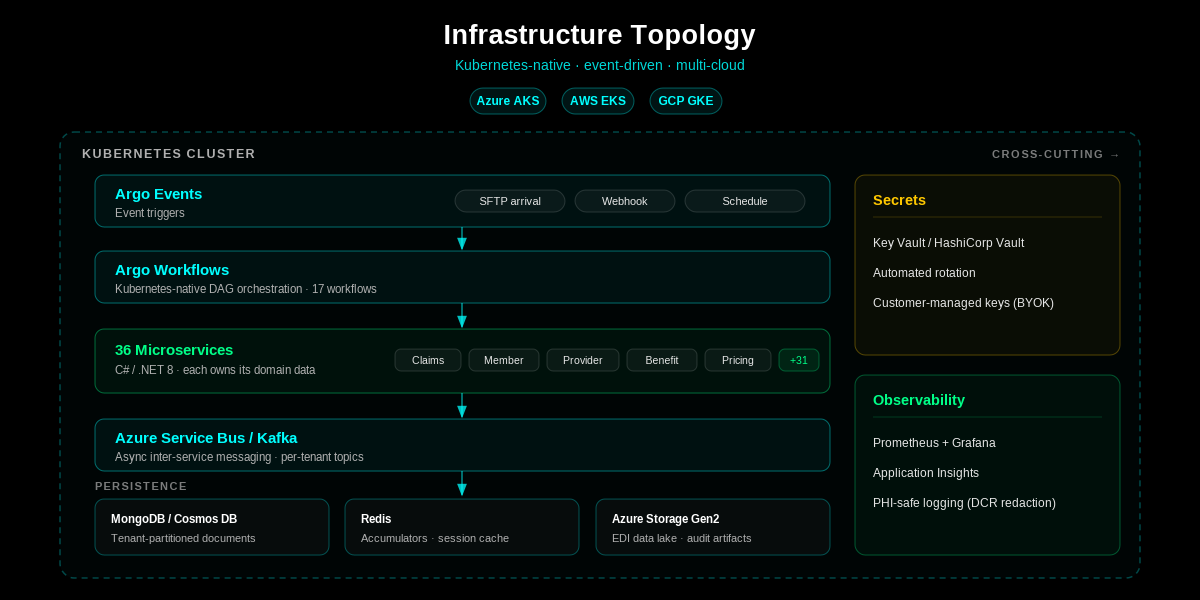
More than 40 .NET 8 services, each owning its domain data and deployed as its own container.
| Domain | Responsibilities |
|---|---|
| Claims | Submission, adjudication, edits, pends, versioning, encounters, real-time claim status |
| Benefit plan | Declarative benefit rules, plan versioning, cost sharing, accumulators |
| Member and coverage | Enrollment (834), eligibility windows, COB, ID cards, personal representatives, consent |
| Provider and network | NPI, network participation, contracts, credentialing, integrity checks across NPPES, OIG/LEIE, and PECOS |
| Authorization | Prior authorization, attachments, requests for additional information |
| Interoperability | All FHIR R4 and CMS-0057-F APIs, CDS Hooks, bulk export, the public Provider Directory |
| Identity and access | SMART authorization server, service-to-service tokens, tenant and trading partner registries |
| Pricing and reference data | Fee schedules and repricing, terminology ConceptMap/$translate, NCCI/MUE tables |
| Payment and finance | Payment runs, 835 remittance, receivables, premium billing, capitation |
| Operations | Work queues, appeals and grievances, care management, correspondence, risk adjustment |
Calculation Engines
Benefit Engine (HDHP/HSA, aggregate family accumulators, DRG inpatient), Fee Schedule Engine (DRG lookup, Medicaid cross-schedule, multiple procedure ranking), NCCI Engine, COB Engine, Risk Adjustment Engine, Encounter Engine, Claims Scrub Engine, Capitation Engine, and Operating Mode Engine.
X12 Processing
Inbound parsers for 837 claims, 834 enrollment, 820 premium payment, 270 eligibility, and 276 claim status. Outbound builders for 271, 277, 835, 834, 999, and TA1. All written in C# with no third-party EDI library. Batch files arrive over SFTP and are orchestrated with Argo Events and Argo Workflows.
CMS-0057-F Interoperability APIs
The FHIR service serves the CMS Interoperability and Prior Authorization Final Rule APIs, and the CMS-9115-F APIs they build on, as FHIR R4.
| API | What it serves | Implementation guides |
|---|---|---|
| Patient Access | Claims, encounters, clinical data, coverage, and prior authorization decisions for a member's own app | US Core 3.1.1, CARIN Blue Button 2.0.0, PDex |
| Provider Access | The same data for in-network providers, scoped to their attributed members, with member opt-out | PDex, Bulk Data, SMART Backend Services |
| Payer-to-Payer | Member match and data exchange with a member's previous or concurrent payer, one member or in bulk | PDex Payer-to-Payer, HRex member match, Bulk Data |
| Prior Authorization | Coverage requirements discovery, documentation templates, and PA submission and status | Da Vinci CRD (CDS Hooks), DTR, PAS 2.2.1 |
| Provider Directory | The plan's networks, practitioners, locations, and plans, with no login | Da Vinci PDex Plan-Net 1.2.0 |
The FHIR service also computes the Patient Access usage metrics plans report to CMS. Bulk export jobs are durable, their files expire after 24 hours, and the feature is enabled per deployment. The public Provider Directory is the one unauthenticated route: it ignores any credential on the request, serves only directory resources, and exists only for plans that have published a directory. See the CMS-0057-F compliance guide for requirement-by-requirement coverage.
Real-Time Eligibility and Claim Status
Trading partners and clearinghouses send real-time 270 eligibility and 276 claim status inquiries over CAQH CORE Connectivity (SOAP 1.2 and MIME) to /core/eligibility and /core/claimstatus. Submitters authenticate with an X.509 certificate, username and password, or OAuth, and each is registered to one tenant. The shared processor handles TA1 and 999 rejections, response time budgets, and published downtime schedules.
Claims Adjudication Pipeline
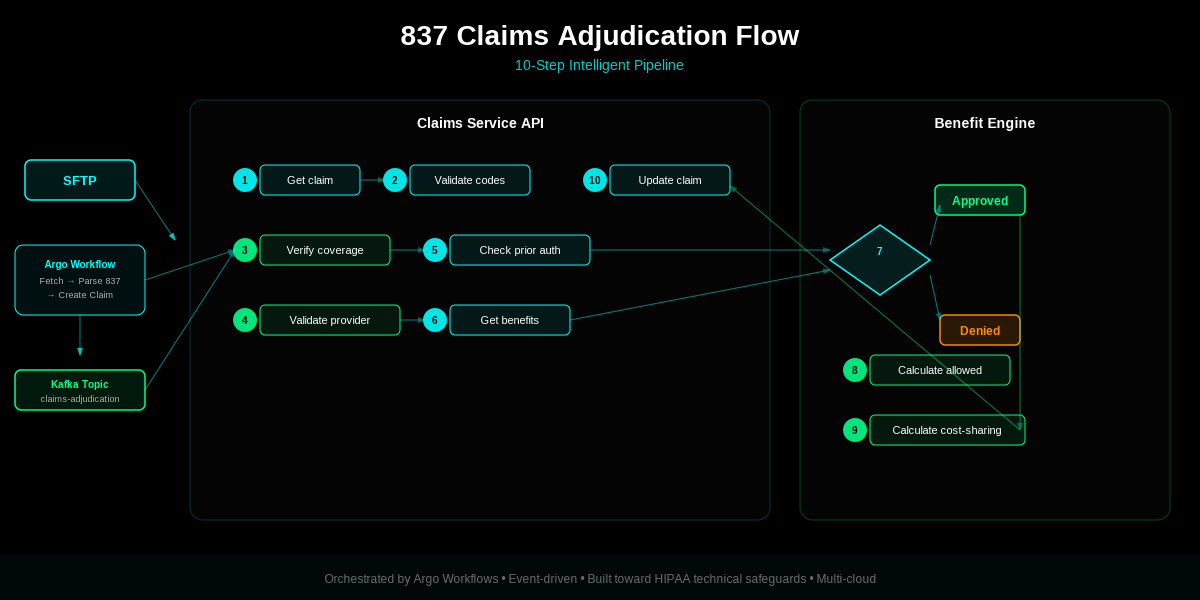
The 10-step pipeline takes an 837 from ingestion to a final, explainable outcome with full benefit calculation.
Pipeline Steps
The pipeline executes: get claim, validate codes, verify coverage, validate provider, check prior auth, get benefits, apply NCCI/MUE edits, calculate allowed amount, calculate cost-sharing (copay/coinsurance/deductible), and update claim status. Each step is individually testable and observable. A claim can correctly finish as paid, denied for a valid business reason, or pended for review, and the platform keeps those outcomes separate from platform errors.
Multi-Tenant Design
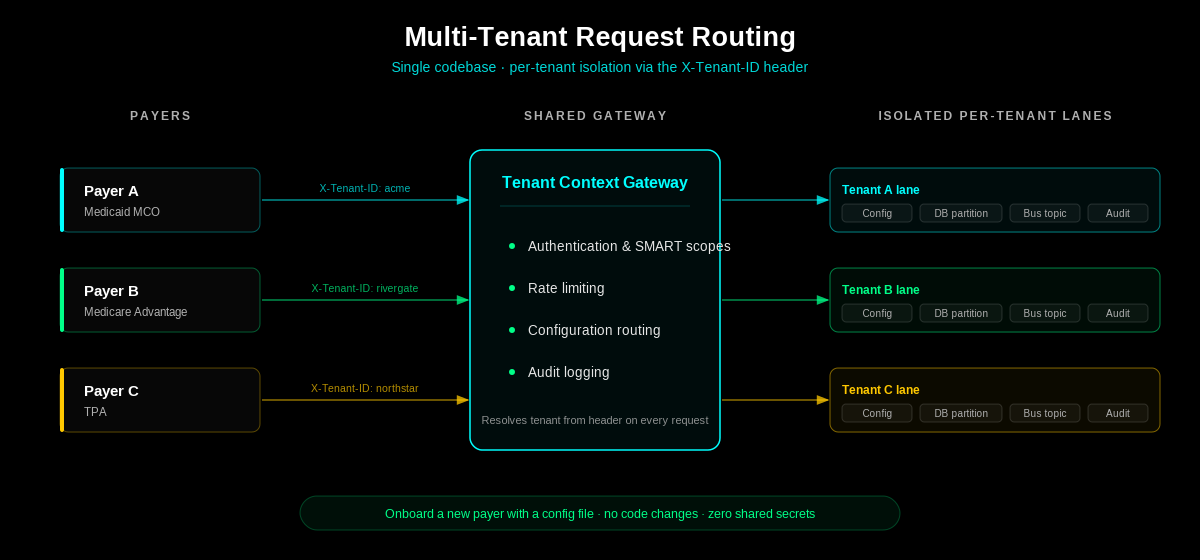
Every authenticated request carries an access token whose signature, issuer, audience, and lifetime are validated before anything else runs. The tenant comes from a claim in that token, and it drives data isolation, configuration routing, and audit logging. An X-Tenant-ID header is accepted only when it matches the token's tenant, so a caller cannot reach another plan's data by changing a header.
Identity and access
CHO's SMART authorization server supports SMART App Launch for member and provider apps and SMART Backend Services (client_credentials with signed JWT client assertions) for systems such as Provider Access and Payer-to-Payer exchange. A token service issues scoped service-to-service tokens, and plans that already run an identity provider such as Entra ID can federate it.
Core admin adapters
A plan does not have to replace its core admin system. Each domain has its own adapter contract, and the tenant's configuration selects the implementation. CHO-native implementations are complete. QNXT, Facets, and HealthEdge connectors are contracts that are built per engagement under the plan's own vendor license, guided by a published implementer guide and conformance tests.
Conformance Evidence
Every night, CI starts the full stack and runs the ONC Inferno test kits for US Core 3.1.1, CARIN Blue Button 2.0.0, Da Vinci Plan-Net, and Bulk Data 2.0.0 with SMART Backend Services, plus Da Vinci scenario tests for PAS, CRD, and DTR against reference implementations. Results are published on the Inferno conformance evidence page. An Inferno pass is evidence, not CMS certification. The Million Claim Challenge does the same for claims correctness and throughput.
Infrastructure
| Component | Technology | Purpose |
|---|---|---|
| Runtime | Kubernetes (AKS, EKS, GKE, on-premises) | Containerized services with per-service deployments |
| EDI orchestration | Argo Events + Argo Workflows | SFTP, webhook, and schedule-triggered batch EDI workflows |
| Messaging | Azure Service Bus / Kafka | Async inter-service events, with a transactional outbox for claims and appeals |
| Database | MongoDB-compatible (MongoDB, Azure Cosmos DB for MongoDB) | Document store with tenant partitioning |
| Reference data | PostgreSQL | Reference code sets only |
| Cache | Redis | Accumulators and low-latency lookups |
| Object storage | Azure Storage Gen2 or equivalent | EDI files, bulk export output, audit artifacts |
| Secrets | Key Vault / HashiCorp Vault | Secrets management, automated rotation |
| Monitoring | Prometheus + Grafana, App Insights | Metrics, dashboards, PHI-safe logging |
HIPAA Security
The platform addresses HIPAA technical safeguards through five layers of defense in depth for PHI:
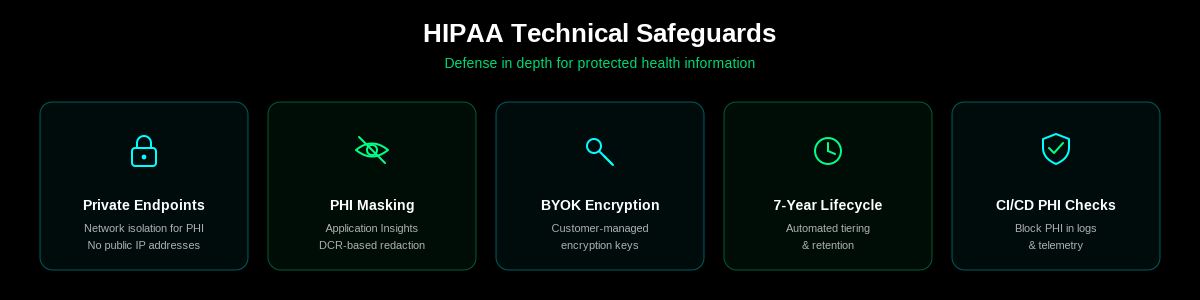
- Private endpoints — network isolation of PHI with no public IP addresses exposed.
- PHI masking — Application Insights redaction using DCR-based rules.
- BYOK encryption — customer-managed encryption keys.
- 7-year data lifecycle — automated tiering and retention.
- CI/CD PHI checks — automated gates designed to keep PHI out of logs and telemetry.
For the full engineering overview, service-by-service breakdown, deployment modes, current gaps, and links to every deep-dive design document, see the ARCHITECTURE.md on GitHub.