CMS-0057-F Compliance Guide
Cloud Health Office delivers a CMS-0057-F readiness surface — FHIR R4 APIs, X12 EDI mapping, SNOMED–CPT–ICD terminology translation, and multi-source provider verification — designed to be validated alongside existing payer core admin systems.
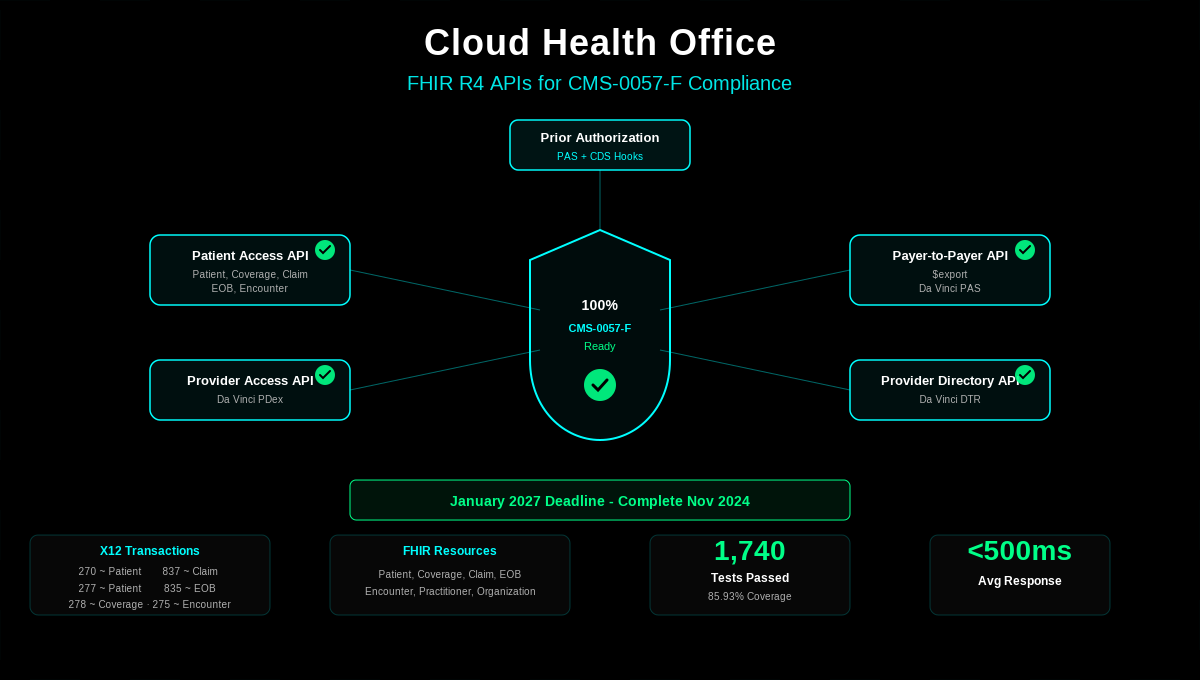
All nine ONC Inferno test kits pass against Cloud Health Office’s CMS-0057-F FHIR APIs: US Core, CARIN Blue Button, Da Vinci Plan-Net, Bulk Data with SMART Backend Services, Da Vinci PDex (payer-to-payer member match), Da Vinci DTR, Da Vinci CRD, Da Vinci PAS and SMART App Launch 2.2. Da Vinci PAS passes every test, including the must-support tests for optional response content. The kits run every night on the main branch. No CMS-0057-F acceptance scenario is a GAP any more: 6 of 21 are PASSABLE and 15 are PARTIAL. What remains is listed in the roadmap below.
Stated plainly: these results come from a test stack with synthetic data, not a production deployment. An Inferno pass covers the groups that ran at that kit version; it is not ONC, CMS or HL7 certification, and CMS-0057-F has no certification program for payer APIs. Each plan’s data mapping and deployment still has to be validated in its own environment.
What is CMS-0057-F?
CMS-0057-F (Advancing Interoperability and Improving Prior Authorization Processes) is a final rule requiring health plans to implement specific FHIR R4 APIs to improve prior authorization workflows, reduce provider burden, and enhance patient care coordination.
The rule applies to Medicare Advantage organizations, state Medicaid and CHIP fee-for-service programs, Medicaid managed care plans, CHIP managed care entities, and QHP issuers on the federally facilitated exchanges. CMS enforces it through each program’s existing oversight: Medicare Advantage contract compliance, state Medicaid and CHIP oversight of managed care contracts, and QHP certification.
All impacted payers must have Patient Access, Provider Access, Payer-to-Payer, and Prior Authorization APIs live in production by this date. Cloud Health Office is designed to help payers stand up and validate that readiness surface without replacing the core admin system first.
Achieving compliance requires more than standing up four FHIR endpoints. The rule depends on Da Vinci Implementation Guides (PAS, CRD, DTR, PDex) that exchange clinical data in SNOMED CT — a code system that payer core admin platforms do not natively speak. It also requires provider directory accuracy and real-time eligibility verification against validated provider records. CHO is built to address the full compliance surface in a single deployable stack: APIs, EDI transformation, terminology translation, and provider data integrity.
Compliance Dashboard
Two kinds of evidence are published, and they are kept separate. Conformance kits are tests we did not write: the ONC Inferno kits, and exchanges with the HL7 Da Vinci reference implementation. Acceptance scenarios are our own 21 CMS-0057-F scenarios, scored PASSABLE, PARTIAL or GAP in the ePA gap matrix (§11), which is the source of truth for requirement-by-requirement status. A kit pass never changes an acceptance status, and the two are never added into one score.
Inferno conformance kits
All nine kits are from one run on November 23, 2026 (run 45091612617), on pull request #1900, and run every night on the main branch. All on synthetic data. Each kit is pinned to a release in interop/versions.json. “Excused” tests are known defects in the kit itself, recorded with the reason and not counted; they are explained on the Inferno results page.
| Kit (version) | Result | CMS-0057-F API it speaks to |
|---|---|---|
| US Core 3.1.1 (us-core-test-kit v1.1.6) | Passed 21/21 | Patient Access, Provider Access, Payer-to-Payer (ONC API floor) |
| CARIN Blue Button 2.0.0 (v0.16.3) | Passed 41/41 · 5 kit issues excused | Patient Access (claims and encounters) |
| Da Vinci Plan-Net (v0.13.4) | Passed 180/180 · 25 kit issues excused | Provider Directory (public, no authentication) |
| Bulk Data 2.0.0 + SMART Backend Services (v0.13.2) | Passed 31/31 | Provider Access and Payer-to-Payer bulk export |
| Da Vinci PDex payer server (v0.13.2) | Passed 13/13 | Payer-to-Payer $member-match |
| Da Vinci DTR 2.2.0 payer server (v0.18.0) | Passed 39/39 · 3 kit issues excused | Prior Authorization (documentation) |
| Da Vinci CRD 2.2.1 server (v0.15.0) | Passed | Prior Authorization (coverage requirements, CDS Hooks) |
| Da Vinci PAS 2.2.1 server (v0.16.0) | Passed | Prior Authorization ($submit, $inquire, pended notifications) |
| SMART App Launch 2.2 (v1.0.3) | Passed | Patient Access and Provider Access authorization (v2 scopes, standalone and EHR launch, Backend Services, token introspection) |
Not covered by any kit run yet: the PDex payer-to-payer query workflow (CHO exchanges data the PDex 2.1.0 bulk way, which kit v0.13.2 does not test), CHO acting as the requesting payer, and system-level $export (not served). Separately, PAS $submit, CRD and DTR are exchanged with the HL7 Da Vinci burden-reduction reference implementation, and all three pass; PAS $inquire is not yet run against it. No kit can check decision timeframes, attribution, consent or metrics reporting; those are covered by the acceptance scenarios below.
Acceptance scenarios and platform capabilities
From the acceptance snapshot published November 22, 2026 (462 acceptance tests passing): 6 PASSABLE, 15 PARTIAL, 0 GAP of 21 scenarios, in Replace mode, where Cloud Health Office is the system of record. A plan that keeps its core admin system (QNXT, Facets, HealthEdge or its own) feeds Cloud Health Office through the daily file drop (CPCDS medical and pharmacy claims, the UM system’s authorizations, and network rosters), and that path is scored separately as “core via file drop”: 1 PASSABLE, 10 PARTIAL, 2 GAP, 8 N/A. The two gaps are writing prior-authorization decisions back into the plan’s own UM system (PAS-03) and clinical data, which the drop does not carry yet (PAT-02). Live core connectors are an optional integration point, built per engagement, and are not scored.
| Requirement | Status | Evidence | Standard |
|---|---|---|---|
| Patient Access API | Partial | PAT-01, PAT-02, PAT-03 PARTIAL; Inferno US Core and CARIN BB pass | CARIN BB 2.0, US Core 3.1.1, PDex |
| Provider Access API | Partial | PROV-02, PROV-03 PASSABLE; PROV-01 PARTIAL; Inferno Bulk Data passes | PDex, Bulk Data 2.0 |
| Payer-to-Payer API | Partial | P2P-03 PASSABLE; P2P-01, 02, 04 PARTIAL; Inferno PDex member match passes | PDex, HRex, Bulk Data 2.0 |
| Prior Authorization API | Partial | PAS-07, PAS-08 PASSABLE; PAS-01 to 06 PARTIAL; Inferno DTR, CRD and PAS pass; PAS, CRD, DTR pass against the HL7 reference implementation | PAS, CRD, DTR 2.2.0 |
| 72-hour expedited and 7-day standard decisions | Partial | PAS-06: deadlines persisted from receipt, escalated by a watchdog, one lawful 14-day extension; PA Timeliness Challenge: 10,000 synthetic requests, 2,601 of 2,601 checks matched | — |
| Public prior authorization metrics | Partial | METRICS-01: CMS metrics computed and annual drafts built; full metric set and publication still open | — |
| Provider Directory API | Kit passes | No acceptance scenario; Inferno Plan-Net passes against the public directory | Plan-Net 1.2.0 |
| OAuth 2.0 / SMART on FHIR | Partial | SEC-01 PARTIAL: PKCE, launch context, approval withdrawal and Backend Services (private_key_jwt) tested; Inferno SMART App Launch 2.2 passes, including v2 scopes and token introspection; production conformance still to validate | SMART App Launch, Backend Services |
| Consent (opt-in and opt-out) | Passable | CONSENT-01 PASSABLE: one registry, opt-in for Payer-to-Payer, opt-out for Provider Access | HRex Consent |
| Terminology Translation (SNOMED ↔ CPT/ICD) | Implemented | ConceptMap/$translate | FHIR R4 ConceptMap |
| Provider Verification | Implemented | Integrity Score Engine | — |
| X12 EDI ↔ FHIR | Implemented | Mapping and parser coverage; X12 278 import of authorizations a core decided | — |
| Claims Adjudication Pipeline | Evidence-backed | Million Claim Challenge benchmark runs | — |
Required APIs
Patient Access API
Empowers patients to access their complete health data electronically — claims history, Explanation of Benefits, clinical data, coverage, and eligibility. Claims are served as CARIN Blue Button ExplanationOfBenefit resources. Patient, Coverage, Encounter and Claim come from Cloud Health Office’s own services, and claims a plan’s core already adjudicated can be loaded from CPCDS extracts. Prior authorizations, with their status, dates and denial reasons, are served to the member as preauthorization EOBs, with drugs excluded. Secured with SMART on FHIR. The Inferno US Core and CARIN Blue Button kits pass. Still open: clinical (USCDI) resources beyond Patient and Encounter come only from payer-to-payer imports today.
Provider Access API
Gives in-network providers access to member clinical and claims data with appropriate consent. An attributed provider is served unless the member has opted out, as the rule requires, and attribution includes members found in claims history. Bulk FHIR Group/$export and Patient/$export for a provider’s attributed panel are built and authenticated with SMART Backend Services; the Inferno Bulk Data kit passes. Bulk export is off by default and is switched on per deployment. Provider identity is validated against CHO’s multi-source provider verification engine.
Payer-to-Payer API
Enables data exchange when members switch health plans. The member’s opt-in arrives as an HRex Consent naming the requesting payer, and only that payer is served. HRex $member-match passes the Inferno PDex kit. Bulk transfer is built (PayerToPayer/$export, PDex Group/$bulk-member-match and $davinci-data-export), off by default, and the export carries the member’s claims and prior authorizations with financial data removed. Outbound requests, where CHO is the new payer, are built behind a transport seam. Still open: validating the export as PDex, and Inferno coverage of CHO as the requesting payer.
Prior Authorization API
Converts the prior auth workflow from phone/fax to real-time FHIR-based requests. Uses the Da Vinci PAS, CRD and DTR implementation guides. PAS $submit stores a durable authorization record before it answers; CRD and DTR exchanges pass against the HL7 Da Vinci reference implementation, and the Inferno DTR 2.2.0 kit passes. Decision deadlines (72 hours expedited, 7 calendar days standard) are persisted from receipt, with the one lawful 14-day extension, and every denied or reduced line carries a coded reason. CHO relies on HHS enforcement discretion for FHIR-only prior authorization; there is no X12 278 bridge, though authorizations a core decided can be imported from X12 278 files. See the ePA gap matrix.
The Prior Authorization API depends on three foundational capabilities that most competing implementations leave as “customer responsibility”:
- Coverage Requirements Discovery (CRD) — Real-time coverage rules evaluated during the provider workflow via CDS Hooks. Requires SNOMED-to-CPT/ICD translation to match clinical codes against payer benefit configuration. CHO's Terminology Crosswalk handles this natively.
- Documentation Templates & Rules (DTR) — FHIR Questionnaire and QuestionnaireResponse for automated clinical documentation collection. Questionnaire answer codes can be resolved across code systems by the crosswalk engine. Questionnaire packages follow DTR 2.2.0 with CQL pre-population (built for the MRI form) and adaptive forms through
$next-question. - Provider Identity Verification — Authorization requests must be validated against credentialed, non-excluded providers. CHO's Provider Verification engine screens against NPPES, OIG/LEIE, PECOS, and state licensing boards in real time.
X12 to FHIR R4 Transformation
Cloud Health Office includes X12-to-FHIR mapping surfaces for core payer transactions. Some paths are implemented directly in the platform and the X12 container uses purpose-built parsing support where appropriate; production use should validate companion guides, trading-partner variations, and payer-specific mappings.
| X12 Transaction | FHIR Resource | Profile | Status |
|---|---|---|---|
| X12 270/271 Eligibility | Patient, CoverageEligibilityRequest/Response | US Core 3.1.1 | Implemented |
| X12 837 Claims (I/P/D) | Claim | Da Vinci PDex | Implemented |
| X12 835 Remittance | ExplanationOfBenefit | Da Vinci PDex | Mapped |
| X12 278 Prior Auth | ServiceRequest, ClaimResponse | Da Vinci PAS | Planned |
| X12 276/277 Claim Status | Claim (status query) | US Core | Implemented |
| X12 275 Attachments | DocumentReference | US Core | Implemented |
| X12 834 Enrollment | Coverage, Patient | US Core | Implemented |
Terminology Translation
CMS-0057-F's Da Vinci workflows (CRD, DTR, PAS) exchange clinical data in SNOMED CT — the terminology used by EHRs and clinical decision support systems. But payer core admin platforms (QNXT, Facets, HealthEdge, Amisys) store and adjudicate claims using CPT and ICD-10-CM codes. This terminology gap is the most commonly overlooked compliance obstacle.
Without built-in terminology translation, a prior authorization request containing SNOMED CT code 73211009 (Diabetes mellitus) cannot be matched to the payer's ICD-10-CM benefit configuration (E11.9, E10.9, etc.). Implementations often treat this as “out of scope” or “customer responsibility”, leaving payers to build their own translation layer or buy a separate product. CHO includes it.
CHO's Terminology Service implements the FHIR R4 ConceptMap/$translate operation with a multi-tier mapping architecture:
| Data Source | Mapping Direction | Entries | License |
|---|---|---|---|
| NLM / UMLS | SNOMED CT → ICD-10-CM | ~119,000 | Free (UMLS license) |
| AMA Cross Maps | CPT ↔ SNOMED CT | Varies | Customer-provided (BYOL) |
| Plan-Specific Overrides | Any direction | Varies | Tenant-scoped |
Context-aware disambiguation
Many SNOMED CT concepts map to multiple target codes. SNOMED 73211009 (Diabetes mellitus) can map to E10.x (Type 1), E11.x (Type 2), E13.x (Other specified), or O24.x (Gestational). CHO's context rule engine uses patient demographics, co-morbidities, and plan-specific coding policy to select the best match — not just the first match.
| Context Signal | Effect | Example |
|---|---|---|
| Patient age | Selects age-appropriate codes | Juvenile diabetes (E10.x) for patients under 18 |
| Patient gender | Excludes gender-impossible codes | Prostate conditions excluded for female patients |
| Patient state | Applies state-specific rules | Texas TMPPM coding conventions |
| Active conditions | Co-morbidity-aware selection | Diabetes + CKD selects E11.22 over E11.9 |
| Plan overrides | Tenant-scoped coding policy | Plan maps 73211009 to E11.65 for all members |
Where the crosswalk fits in CMS-0057-F
The Terminology Service is consumed by three CHO microservices at runtime to fulfill CMS-0057-F requirements:
- CRD Server — Translates SNOMED CT codes from EHR CDS Hook requests into the payer's CPT/ICD code space, then checks against benefit configuration to determine prior auth requirements.
- PAS Server — Designed to translate procedure and diagnosis codes using
$batch-translate(X12 278 ↔ FHIR conversion is planned) for low-latency bulk translation in real-time prior auth decisions. - DTR Engine — Resolves questionnaire answer codes across code systems so pre-populated FHIR QuestionnaireResponse values are clinically accurate and machine-readable.
For the complete API reference, map management, context rule engine, and portal integration details, see the Terminology Crosswalk Guide. To see live translations in a guided session, contact Sales to schedule a walkthrough.
Provider Verification & Integrity
CMS-0057-F requires a Provider Directory API and provider data accuracy for the Provider Access API. Authorization requests, claims adjudication, and provider directory lookups all depend on verified, current provider records. CHO's Provider Verification Engine aggregates data from five authoritative federal and state sources into a composite Provider Integrity Score (0–100) per NPI.
| Data Source | What It Checks | Update Frequency |
|---|---|---|
| NPPES (NPI Registry) | NPI validity, practice address, taxonomy, enumeration status | Daily |
| OIG / LEIE | Federal exclusion screening — excluded providers cannot participate in federal programs | Monthly |
| PECOS | Medicare enrollment status and participation eligibility | Monthly |
| CMS Open Payments | Industry relationship disclosure for transparency and conflict-of-interest awareness | Annually |
| FSMB / State Licensing | Active medical license verification, disciplinary actions, multi-state compact status | Varies by state |
The composite score is computed using a weighted algorithm across all five sources. Providers below a configurable threshold (default: 60) are flagged for review. Excluded providers (OIG/LEIE match) are automatically blocked from authorization and claims processing. All verification results are audit-logged with timestamps and source data versions for compliance documentation.
Where provider verification fits in CMS-0057-F
- Provider Access API — Provider identity is verified before granting access to member clinical and claims data. NPI is validated against NPPES, exclusion status is checked against OIG/LEIE, and license status is confirmed.
- Prior Authorization API — Requesting and servicing provider NPIs are verified during PAS submission. Excluded or unlicensed providers trigger an automatic deny with structured rationale.
- Provider Directory API — Directory entries are enriched with verification metadata, ensuring that provider information exposed through FHIR endpoints reflects current, validated data.
- Claims Adjudication — Step 4 of the 10-step adjudication pipeline validates the servicing provider before benefit calculation proceeds.
For the complete scoring algorithm, bulk sync infrastructure, API reference, and portal integration, see the Provider Verification Guide.
State-Level Compliance
Beyond federal CMS-0057-F requirements, CHO ships with state-specific compliance rules that apply automatically to tenants operating in those states. Platform-level seed rules enforce state regulatory floors — tenants can override parameters or disable rules, but cannot delete platform rules.
Why Cloud Health Office
CMS-0057-F compliance is not just an API problem — it is an integration, terminology, data quality, and adjudication problem. Most implementation approaches address only the FHIR API surface and leave the rest as “customer responsibility.” CHO addresses the full compliance surface in a single platform.
| Capability | CHO | Typical Implementation |
|---|---|---|
| FHIR R4 APIs (Patient, Provider, P2P, PA) | Built-in | Varies — often assembled from third-party tooling |
| X12 EDI Mapping | Implemented mapping surfaces | Third-party libraries or manual mapping |
| SNOMED ↔ CPT/ICD Terminology Translation | Native ConceptMap/$translate | Not included — “customer responsibility” |
| Context-Aware Disambiguation | Rule engine with plan overrides | Not available |
| Provider Verification (NPPES, OIG, PECOS, FSMB) | Multi-source Integrity Score | Manual or separate product |
| Claims Adjudication Pipeline | 10-step DAG, sub-second | Depends on legacy CAPS |
| Benefit Engine (HDHP, HSA, COB, NCCI, DRG) | 9 calculation engines | Depends on legacy CAPS |
| Core Admin Adapter Pattern | Vendor-neutral ICoreAdminAdapter | Hard-coded to one CAPS |
| Multi-Tenant SaaS | Tenant taken from the validated access token | Single-tenant or per-client deployment |
| Evaluation Timeline | <1 hour local start | 6–18 months |
CHO deploys as a compliance layer alongside your existing core admin platform — QNXT, Facets, HealthEdge, Amisys, or any other system. No replatforming. No rip-and-replace. Your CAPS stays in place. CHO handles FHIR, EDI, terminology, provider verification, and CMS compliance. The ICoreAdminAdapter pattern means CHO can operate in Augment mode (compliance overlay on your CAPS) or Replace mode (standalone core admin) per tenant. The default way a core feeds CHO is the daily file drop: CPCDS members, coverage and claims, and UM authorizations as CSV or X12 278. Every CMS-0057-F API reads what the drop loaded, and the evidence above scores that path on its own. Live connectors that call the core per request (QNXT, Facets, HealthEdge) are an optional integration point, built and validated during an engagement for a plan that prefers them.
Compliance Deadlines
| Requirement | CMS Effective Date | CHO Status (November 2026) |
|---|---|---|
| Patient Access API (prior authorization data) | January 1, 2027 | Partial — built; US Core and CARIN BB kits pass |
| Provider Access API | January 1, 2027 | Partial — built; Bulk Data kit passes |
| Payer-to-Payer API | January 1, 2027 | Partial — built; PDex member-match kit passes |
| Prior Authorization API | January 1, 2027 | Partial — built; DTR and CRD kits and Da Vinci reference exchanges pass; PAS kit use cases pass |
| Prior authorization decision timeframes | January 1, 2026 | Partial — tracked from receipt |
| Public prior authorization metrics | March 31, 2026, then annually | Partial — computed; publication open |
| Terminology Translation | Required for CRD/DTR/PAS | Implemented since March 2025 |
| Provider Directory API | In force since CMS-9115-F | Plan-Net kit passes — published per plan |
Roadmap: what remains
Everything below is open work, listed so a plan can see it before it signs anything. Each plan’s go-live date and sequencing are agreed in its own implementation plan.
Before January 1, 2027
- Patient Access: serve clinical (USCDI / US Core) resources from a plan’s own sources, not only from payer-to-payer imports.
- Payer-to-Payer: validate the export against PDex profiles, and run the Inferno PDex payer-client suite with CHO as the requesting payer.
- Prior Authorization: run PAS
$inquireagainst the HL7 Da Vinci reference implementation; full DTR answer validation and canonical resolution. - Metrics: complete the CMS metric set and support each plan’s publication of its annual report.
- SMART on FHIR: validate the full token response and SMART conformance in a production deployment (the Inferno SMART App Launch 2.2 kit passes on the test stack).
- Per plan: load and validate the plan’s own data, then run the same Inferno kits against its deployment (
./scripts/interop/run.sh deployment).
Planned
- SOC 2: Aurelianware plans to pursue a SOC 2 examination. No SOC 2 report exists today; see Trust & security for the current security posture and what is not claimed.
- Live core connectors: optional QNXT, Facets and HealthEdge connectors, built and validated with a plan that prefers them over the file drop. Off by default and not scored.
- File-drop gaps: write-back of prior-authorization decisions into the plan’s UM system, and clinical data in the drop.
- System-level bulk export: not served today; not required by CMS-0057-F.
Verify it yourself
You don’t have to take our word for any of this. The Inferno kits are free and public, and so is the harness that runs them. From a clone of the repository:
# Run every pinned Inferno kit against a local Cloud Health Office stack (Docker)
./scripts/interop/run.sh inferno all

# Or one kit: us-core | c4bb | plan-net | bulk-data | pdex | dtr
./scripts/interop/run.sh inferno dtr

# Exchange PAS, CRD and DTR with the HL7 Da Vinci reference implementation
./scripts/interop/run.sh br-payer all

# Point the US Core, CARIN BB and Plan-Net kits at a deployed CHO
CHO_INTEROP_TARGET_URL=https://your-cho/fhir/r4 ./scripts/interop/run.sh deployment
The same kits are hosted at inferno.healthit.gov, so a plan can point them at a Cloud Health Office sandbox, or at any vendor’s, and read the findings for itself. The nightly results, including the excused kit issues, are on the Inferno conformance page.
For the full commercial breakdown including cost comparisons and implementation timelines, see the CMS-0057-F Compliance product page.
Related Compliance Guides
- Terminology Crosswalk Guide — Full API reference, map management, context rule engine, portal integration, and consumer service architecture
- Provider Verification Guide — Multi-source verification engine, integrity scoring algorithm, bulk sync, and claims integration
- Finance Guide — Premium billing, accounts receivable, capitation payments, X12 835 ERA generation, and NACHA ACH disbursement
- Architecture — Platform overview, 10-step adjudication pipeline, multi-tenant design, infrastructure, and HIPAA security