Secure development checks
Automated dependency, secret, container, and PHI-focused checks run in the public repository. Findings still require review and remediation.
Cloud Health Office is source-available payer infrastructure, not a black-box certification claim. This page distinguishes controls visible in the repository, reference deployment patterns, customer responsibilities, cloud-provider assurance, and the work required before production PHI processing.
A repository control, a reference architecture, and a production operating control are different things. Cloud Health Office keeps those categories separate so a security review can test the right evidence.
Automated dependency, secret, container, and PHI-focused checks run in the public repository. Findings still require review and remediation.
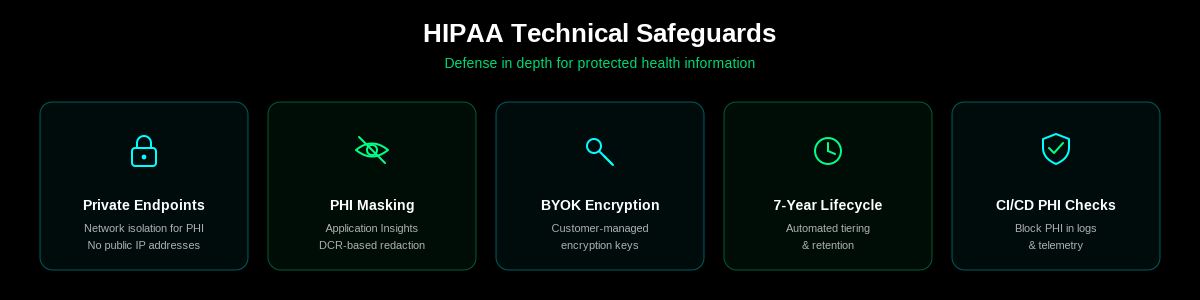
Infrastructure supports private endpoints, managed identities, RBAC, key-management options, audit logging, and tenant-aware routing.
Identity, networks, keys, logging, retention, integrations, recovery, and operating procedures must be verified in the target environment.
This site does not claim that Aurelianware or Cloud Health Office currently holds SOC 2 Type II or HITRUST certification.
PHI processing, support coverage, incident-notification targets, availability commitments, and retention terms are defined per engagement.
Published benchmarks are local validation evidence. Production capacity and regulatory posture require customer-specific testing and review.
The final boundary varies by operating model, but responsibility never disappears into a generic “HIPAA-ready cloud” statement.
| Control domain | Cloud Health Office provides | Customer validates and operates | Cloud provider provides |
|---|---|---|---|
| Identity and access | Authentication, authorization, RBAC, tenant-context, and managed-identity integration patterns. | Identity-provider configuration, role assignments, access reviews, MFA policy, and workforce lifecycle. | Identity and key-management service availability and underlying platform controls. |
| Data protection | Encryption configuration, PHI-aware logging, data partitioning, retention options, and secret-store integration. | Approved data classes, key ownership, retention schedule, backup policy, export controls, and deletion acceptance. | Encryption primitives, regional storage services, physical media controls, and documented service assurance. |
| Network security | Private-endpoint, ingress, egress, service-to-service, and network-policy reference patterns. | Production topology, DNS, firewall, allow-list, egress, certificate, and administrative-access configuration. | Virtual-network and managed-service isolation capabilities plus infrastructure availability. |
| Monitoring and response | Structured audit events, telemetry redaction patterns, health signals, and alerting templates. | Alert routing, on-call coverage, SIEM integration, incident command, evidence retention, and notification decisions. | Platform logs, regional status, native monitoring services, and provider incident communications. |
| Compliance and contracts | Control documentation, implementation evidence, architecture review, and contract-specific commitments. | Risk analysis, policies, vendor review, BAA determination, regulatory interpretation, and production acceptance. | Service-specific compliance documentation and contractual terms for eligible cloud services. |
Public evaluation begins with deterministic synthetic data. A production PHI workload is a separate, governed step with explicit contractual, architectural, and operational prerequisites.
Public source does not make software secure by itself. It does make the checks, changes, and unresolved work easier to inspect.
main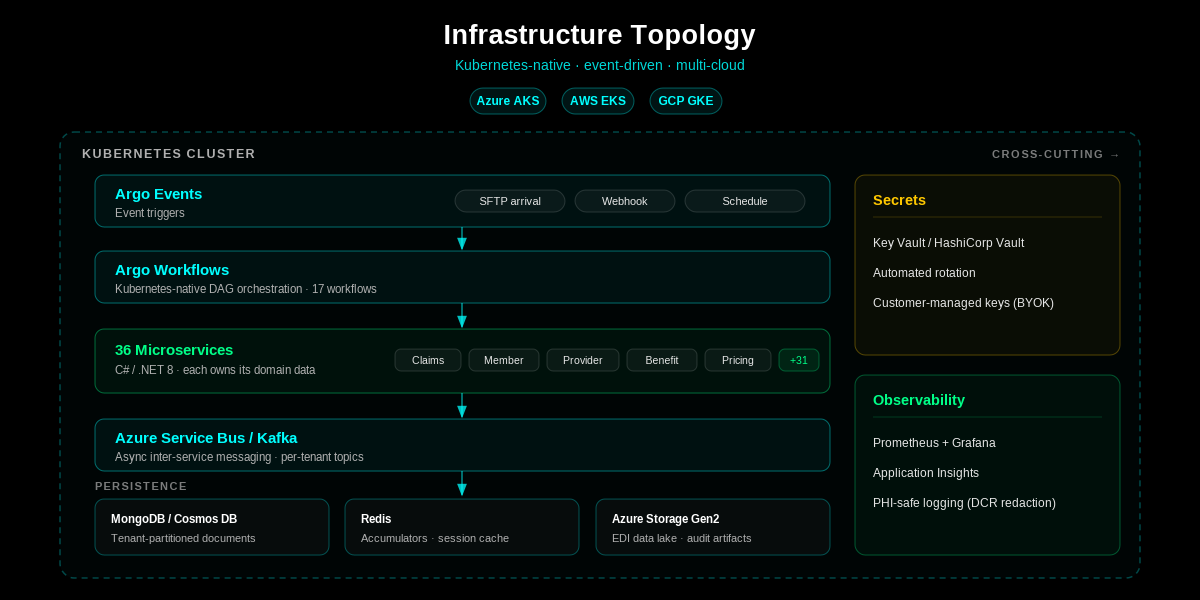
These controls are implemented in the public source as of October 2026. They are a current-state architecture note for a payer security review, not a SOC 2 Type II report, a HITRUST certification or a penetration-test letter.
| Control | How it is implemented |
|---|---|
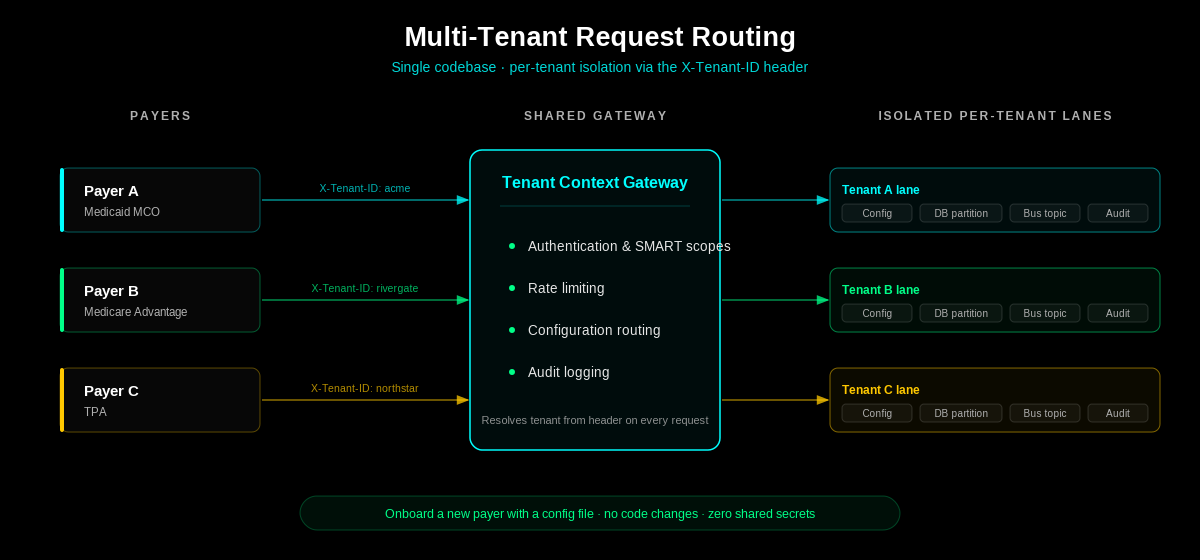
| Tenant isolation | The tenant comes only from a validated token. A token without a tenant is rejected, a tenant header that disagrees with the token is refused, and there is no default tenant. Every repository query is filtered by tenant. |
| Authentication and authorization | Every service requires a Cloud Health Office token and every endpoint is permission-gated; an endpoint without a stated permission falls back to the service’s default read or write permission, and is refused if there is none. Service-to-service calls carry the calling service’s own identity. External FHIR clients use SMART on FHIR with scope enforcement and patient binding. |
| Secrets | Secrets are read from a key vault configuration provider. No production secrets are kept in source control, and secret scanning runs in CI. |
| Encryption | TLS on ingress; mesh or cluster-level encryption is a deployment choice. At rest, store and key-vault managed keys on Azure deployments, plus field-level encryption for appeals PHI. A customer-managed key module exists but is not wired into the default deployment. |
| PHI in telemetry | OpenTelemetry traces pass through a PHI-scrubbing span processor. |
| Record-access audit | Member, authorization, provider and payment services log who read which record, whether allowed or denied. Reading the access log requires its own audit permission. |
| Dependency and code scanning | Dependabot, Trivy and gitleaks run on the repository, and CodeQL static analysis runs weekly and on every pull request. |
Do not disclose security vulnerabilities, PHI, credentials, or tenant data through public issues, discussions, pull requests, or comments.
security@cloudhealthoffice.com is the private reporting channel.
Include the affected component, steps, potential impact, and redacted evidence. Do not include real PHI or production credentials.
Coordinate disclosure privately while the issue is evaluated and remediated. Public reporting can follow an agreed disclosure path.
Production readiness is an acceptance process, not a checkbox inherited from a repository or cloud provider.
Identify workflows, users, integrations, data classifications, regions, recovery objectives, operating model, and regulatory responsibilities.
Test identity, authorization, isolation, encryption, redaction, auditability, recovery, capacity, failure handling, and operational procedures.
Execute required agreements, record exceptions, approve evidence, establish support and incident paths, and monitor the accepted control baseline.
We will review the source-visible controls, identify deployment-specific gaps, and define the evidence required before your organization accepts a pilot or production workload.